
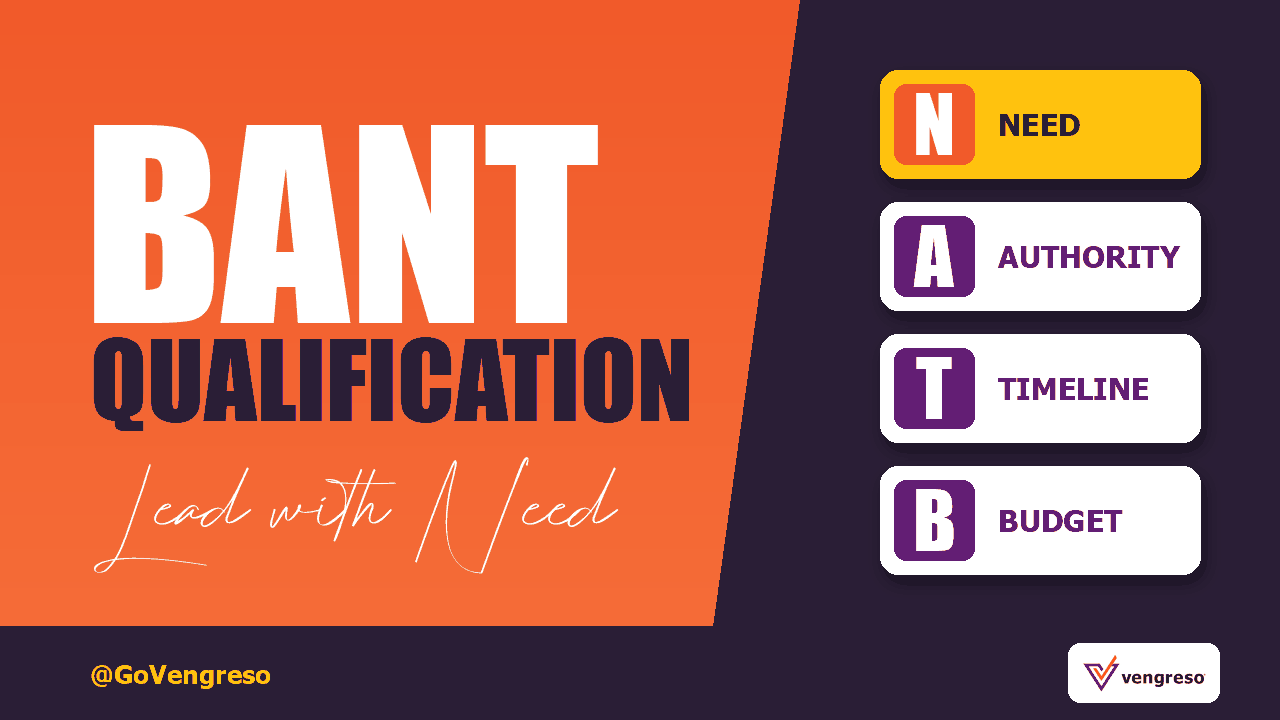

BANT stands for Budget, Authority, Need, and Timeline. It is a sales qualification framework that helps your reps figure out whether a prospect is worth pursuing, before they invest weeks chasing a dead end. As a manager, your job is to coach reps to use BANT as a conversational discovery lens, not a stiff checklist they read off a screen.
Conversational BANT also means reading the person in front of you. A direct executive wants you to get to the point and may push toward numbers early. A relationship-first buyer will shut down if money comes up before there’s any trust. In FlyMSG AI Sales Roleplay and Coaching, a practice scenario can generate buyers across 16 personality types, so your reps can try the same BANT questions on very different people and hear how the reaction changes.
Key Takeaways
- BANT stands for Budget, Authority, Need, and Timeline, and it remains one of the most widely used qualification frameworks in B2B sales.
- Modern sales teams should flip the classic order and lead with Need first, then Authority, Timeline, and Budget last, to build trust and keep conversations open.
- BANT is a lead qualification lens for discovery calls, not a rigid script. Qualifying a lead using BANT is rarely a rigid checklist.
- Coaching and regular practice are what separate teams that use BANT well from teams that just fill in CRM fields. Under pressure, reps skip qualification questions, and your coaching plan is the fix.
- Tools like FlyMSG AI Sales Roleplay and Coaching help reps build natural discovery habits by rehearsing BANT conversations with AI buyers who actually push back.
Quick Answer: How BANT Works in Modern Sales
BANT stands for Budget, Authority, Need, and Timeline. It is a BANT sales qualification framework that helps you evaluate whether a prospect has the pain, the people, the timing, and the money to move forward. We recommend running it as Need, then Authority, then Timeline, then Budget. It is a valuable tool for qualifying opportunities and protecting your team’s time, not for interrogating buyers.
Here is what BANT helps you do as a sales manager:
- Spot qualified leads fast. BANT helps sales teams filter prospects and focus on deals most likely to close. It improves sales efficiency by helping representatives prioritize promising prospects.
- Coach consistent discovery. Sales teams use BANT to guide discovery conversations and prioritize leads. When everyone uses the same four criteria, your pipeline reviews get sharper.
- Decide where to invest. BANT helps prioritize leads with the highest conversion potential. You can quickly see which deals deserve full proposals and which need more nurture before they are ready.
If you are a busy sales manager who wants to tighten pipeline quality, BANT gives you a shared language to coach your reps and align with your marketing teams on what “qualified” actually means.
What Is the BANT Sales Framework?
The BANT sales framework stands for Budget, Authority, Need, and Timeline. BANT came out of IBM decades ago as a way to help sales representatives quickly decide whether a lead was worth pursuing. Despite being decades old, it remains widely used across B2B sales organizations as an initial qualification tool.
BANT is a lead qualification framework, not a full sales methodology. Think of it as the lens your reps use during discovery calls and early sales conversations to filter out tire-kickers from real buyers. It is not a closing technique. It is not a negotiation playbook. It is the first filter that keeps your team from burning hours on deals that were never going to happen.
BANT sales helps reps move from “nice conversations” to structured lead qualification that supports accurate forecasting. When your reps can answer all four BANT questions about a deal, you know whether that opportunity belongs in the pipeline or in a nurture sequence.
BANT provides a structured lens for evaluating a prospect’s readiness to buy, and each BANT element can be adapted to fit your team’s process and industry. For some deals, the BANT method should remain the core before you layer on deeper frameworks like MEDDIC. But BANT remains the baseline lens for every stage of your sales process, especially for teams running shorter, more transactional deals.

Why BANT Still Matters for Lead Qualification
Some sales teams have plenty of meetings and still miss their number because the pipeline is full of deals that were never qualified. Their reps are booking meetings, running demos, writing proposals, and then watching deals stall because there was never a real budget, a real timeline, or a real decision maker involved. BANT addresses that problem head-on by tightening the lead qualification process before your team invests serious time.
BANT enables sales teams to avoid wasting resources on unqualified prospects. It helps sales teams allocate resources efficiently by focusing on high-value opportunities. And it can help shorten sales cycles by identifying purchasing barriers early, so your reps either fix those barriers or walk away sooner.
Here is what BANT gives you as a manager:
- Consistent language for pipeline reviews. When every rep qualifies using the same four key criteria, your weekly deal reviews become clearer and faster.
- Better coaching conversations. You can point to specific BANT gaps (“You have Need and Timeline, but where is Authority?”) instead of giving vague feedback like “do better discovery.”
- Alignment between sales and marketing teams. BANT establishes a shared definition of a qualified lead between sales and marketing. The BANT framework aids in connecting sales and marketing by establishing objective standards for lead quality. This stops the misalignment that occurs when marketing hands over unvetted contacts that sales rejects as bad leads.
Here is a quick example. Imagine one of your reps just spent three weeks running demos for a mid-market SaaS prospect. The champion loved the product. But when it came time to send a proposal, the champion admitted they had no approved budget, their VP had never heard of your product, and there was no timeline beyond “maybe next year.” Three weeks gone. A two-minute BANT check on the first call would have flagged every one of those gaps.
Under pressure, reps skip the basics. They get excited about a prospect and move the deal forward without confirming budget, authority or timing. BANT gives them a simple framework to stay disciplined.
Buyers also do more research on their own before they ever talk to your team. In 2025, Gartner found that 61% of B2B buyers prefer an overall rep-free buying experience. When a buyer finally picks up the phone, BANT helps your rep figure out whether that prospect is truly in a buying process or just browsing.
Reframing BANT: From Rigid Checklist to Conversation Lens
BANT often fails when a rep fires off “What’s your budget?” and “Are you the decision maker?” in the first ten minutes of a call. That approach makes prospects defensive. They feel interrogated, not helped. And they stop sharing useful information.
BANT’s application has become more flexible and nuanced over the years. Qualifying a lead using BANT is rarely a rigid checklist, and it should not sound like one on a call. Your job as a manager is to present BANT to reps as a set of outcomes to understand by the end of discovery, not a fixed list of questions to read in order.
Here are some principles to coach into your team:
- Teach reps to earn the right to deeper BANT questions. Open with curiosity about the prospect’s challenge and goals. Let the harder questions (authority, budget) come after trust is built.
- Tie each question to the buyer’s world, not your forecast needs. That keeps the conversation out of the seller’s perspective and focused on how the customer evaluates change. Instead of “I need to know your budget for my pipeline,” try “Help me understand how your team has funded similar projects so I can tailor what I show you.”
- Treat BANT as a conversation map, not a form to fill out. Reps should weave the four criteria into a natural back-and-forth. If they hit all four by the end of the call, great. If they only get two, they know exactly what to ask on the next call.
Mario Martinez Jr., Vengreso’s CEO, puts it this way: keep the science, add the art. The science is what you need to know: budget, who signs, when they’re on vacation. The art is getting it inside a human conversation. Before the next question, validate what the buyer just told you, like “Wow, that sounds challenging,” then follow up. Mario compares it to someone who trips and falls. One person asks “Are you OK?” and keeps walking. The other says “Hold on, let me help you.” Be the second one. In his words, sales is the art of helping.
Recommend that BDRs and AEs both use softer language and follow-up questions to keep the tone consultative rather than interrogative. The difference between a bad BANT call and a good one is not what you ask. It is how you ask it.
Flip The Order: Why BANT Should Start With Need
Classic BANT starts with Budget. That made sense when IBM created it, selling to companies that had rigid budgets set in annual planning cycles. But modern buying committees often do not have a pre-set budget line item when they first talk to your reps. Budgets get created once the buyer sees enough value and pain to justify the investment.
Modern sales require a need-first approach to BANT qualification. Lead with Need questions to build rapport before discussing budget. The recommended flow is:

- Need – What problem or goal is driving this conversation?
- Authority – Who else is involved in evaluating and deciding?
- Timeline – What is driving the urgency (or lack of it)?
- Budget – How will this be funded, and what range makes sense?
This aligns with customer-centric discovery because it puts the buyer’s problem at the center of the conversation, not your pricing.
Here is a quick example. Imagine a rep calls an inbound lead and opens with “Great, so what’s your budget for this?” The prospect freezes. They have not been given money yet. They are still trying to understand their own problem. They mumble something vague, and the rep either disqualifies too early or presses harder, which kills trust.
Now imagine that same rep opens with “Tell me what changed recently that made you start looking at solutions like ours.” The prospect leans in. They start talking about a broken process, a missed quarterly target, a frustrated team. Twenty minutes later, the rep knows the need, the stakeholders, and the timeline. Budget becomes a natural follow-up once the value is clear.
As a manager, inspect call notes or recordings to verify that reps are not leading with price talk before Need is clear. If you spot it, coach it immediately.
“N” for Need: Getting Past Surface-Level Pain
Need is the foundation of the BANT sales framework because no pain means no deal. It does not matter if a prospect has budget, authority, and a timeline. If they do not feel a real need to change, they will not buy. Your reps need to identify pain at a level that goes beyond “we want more leads” or “we need a better tool.”
Here are concrete discovery questions your reps can use this week:
- “Walk me through what made this a priority for your team right now, and how it connects to your broader business goals.”
- “What breaks or falls behind when your current process does not work?”
- “How does this impact your team’s targets for this quarter?”
- “What happens if nothing changes and you stay on the current path?”
- “How is this affecting your revenue, costs, or headcount?”
The key coaching move here is teaching reps to follow up. A generic need statement like “We want to improve our onboarding” is a starting point, not a finish line. The rep should dig for quantified impact. How many hours are wasted each week? How much revenue is at risk? What compliance problem gets worse?
Walk in with a hypothesis. Before I ever say hello, I know the top two or three problems a buyer in that role usually has. On the call I name them and let the buyer pick: “Normally when I meet with VPs of Sales, they’re dealing with [problem one], [problem two] or [problem three]. Are any of those challenges you’re facing?” Why it works: it shows the buyer you know their world, and they choose their pain instead of sitting through twenty questions.
Then I size it with four questions. How big is this problem? How bad is it? How much do you want to change it? What happens if you do nothing? Those answers tell you whether the pain is big enough to fund a fix, which is what Need is really asking.
One more Need question before you celebrate a deal that checks every box: “Why now? What’s changed?” Keynote speaker and author Meridith Elliott Powell shared a story on The Modern Selling Podcast about a CEO who came up after a talk and wanted her to work with his sales team. Every box was checked until she asked why now. The real problem was a brother-in-law he had put in charge of sales and would not touch. She knew she couldn’t make that team successful, so she thanked him and moved on. Mario added “why now” to Vengreso’s own prospecting questions the day he heard that story.
Here is a short example of what a deeper Need conversation sounds like:
Rep: “You mentioned onboarding is taking too long. Help me understand what ‘too long’ means for your team.”
Prospect: “New reps take about four months to ramp. We’d like that under three.”
Rep: “Got it. What does that extra month cost you? Is it mostly lost quota, or is there a retention issue too?”
Prospect: “Both, honestly. We lost two reps last quarter who got frustrated before they ramped. Replacing them cost us about $30K each.”
Rep: “That’s $60K just in turnover, plus the missed pipeline from those seats being empty. Is that the kind of number that would get your leadership’s attention if we could cut ramp time?”
Notice that the rep did not ask “What’s your budget?” or “Are you the decision maker?” They stayed in the prospect’s world, quantified the pain, and made the problem feel real. That is how you move from surface-level need to a deeper understanding of business impact.
Instruct your reps to listen actively during these moments. The prospect’s challenge will tell you everything about urgency, stakeholders, and budget, if you ask the right follow-ups.

“A” for Authority: Mapping Real Decision-Making Power
Authority is not about finding “the decision maker.” In most B2B deals, there is no single person who writes the check, approves the vendor, and signs the contract alone. Several stakeholders usually weigh in. Your reps need to map the full decision making process, not just find one name.
Authority in the BANT framework is really about understanding the buying committee: who influences, who evaluates, who approves, and who can kill the deal. That includes executives, finance, procurement, legal, IT, and sometimes end users.
Here are coaching-friendly questions your reps should ask:
- “Who besides you will weigh in on evaluating something like this?”
- “What steps does your organization usually go through before a decision like this is signed?”
- “Is there someone from finance or legal who needs to review before you can move forward?”
- “Who on your team would be most affected by this change?”
As a manager, ban the phrase “Are you the decision maker?” from your team’s vocabulary. It almost always gets a false “yes” or makes the prospect uncomfortable. Replace it with collaborative language that respects the champion’s role while mapping the rest of the decision makers.
Ask for the committee, not the decision maker. When I train sales managers, I ask the room to raise a hand if they’ve asked a rep “Who’s the decision maker?” in the last 30 days. Every hand goes up. A few minutes earlier, the same managers told me their small and mid-size deals have three or four buyers each. Why ask for one name? I teach reps to ask, “Who’s on the decision-making committee? Names and roles?” Then plan how you’ll reach each of those people. That one change turns Authority from a yes or no into a map you can work.
Here is why this matters in practice. Imagine one of your reps builds a great relationship with a mid-level marketing director. They run three demos, customize a proposal, and feel confident about closing. Then in week five, the director says “Oh, our CFO needs to sign off on anything over $10K, and procurement has a 30-day review process.” The deal stalls for two months.
If the rep had asked “What does the approval process look like for a project like this?” in the first call, they would have known about the CFO and procurement from the start. They could have looped in the economic buyer earlier, tailored the business case for finance, and planned for the procurement timeline.

Authority questions are not about decision making power alone. They are about understanding the full decision process so your team is never surprised late in the deal.
“T” for Timeline: Sorting Real Opportunities From Someday Projects
The Timeline criterion in BANT helps your team distinguish active buying cycles from casual research. A prospect who says “We need this by March because our current contract expires March 31” is in a very different place than one who says “We’re just exploring for sometime next year.” Getting clear on timing helps both you and the prospect decide whether this is an active initiative or a future project.
Timeline directly affects your forecast accuracy. When your reps capture strong timeline data, you can predict which deals will close this quarter and which ones belong in a future pipeline bucket.
Here are concrete timeline questions your reps should ask:
- “What is driving your target date for having this in place?”
- “What happens if this slips by a month or a quarter?”
- “Are there external deadlines pushing this, like a contract renewal or a compliance date?”
- “When does your team need to see results from this investment?”
Three qualifying questions, not four. On a cold call, Mario keeps qualification to three questions: who do you use for this today, when did you sign and when does it end, and a fit question like how many users you have or whether you’re happy. A fourth question goes past the scope of a cold call and can cost you the call.
The contract date tells you how hard to push:
- A 12-month contract, two months in: book the meeting now and start building trust.
- A 36-month contract, two months in, with a happy rollout: don’t push. Stay in touch and set a six-month check-in.
- Ask “How is the implementation going?” and hear “horrendous”: that’s your signal to move in now.
Mario’s date test. Mario trained his sales teams to test every target date with two questions: “What happens if this moves past that date?” and “Who do you report to, and how do they feel if it isn’t done by then?” A real consequence, like a system going off maintenance and getting shut down, is a date you can forecast. A convenience is not. James Muir’s example on The Modern Selling Podcast was “the doctors are on vacation then.” That date will slip. Ask more than one person, because some people in a complex deal would rather have no date at all.
Coach your reps to anchor the prospect’s timeline to external triggers. Internal deadlines (“We’d like it done by Q1”) shift easily. External triggers (contract renewals, regulation deadlines, product launches, board meetings) are harder to move. When a rep can tie the timeline to something the prospect cannot control, you have a much stronger signal.
Recommend using CRM fields to capture both the stated date (for example “target go-live: March 15”) and the trigger event (“current vendor contract ends March 31”). That way, when you review the sales pipeline in your weekly meeting, you can quickly see which deals have real urgency and which ones are floating.
BANT can reduce sales cycles by addressing budget and authority early, but timeline is where you separate “interested” from “buying.” If there is no trigger, there is probably no deal this quarter.
“B” for Budget: Talking Money Without Killing Rapport
Budget is where most reps get uncomfortable, and most prospects get defensive. That is why we recommend moving Budget to the end of the BANT framework, after Need, Authority, and Timeline are clear. When the buyer already feels understood and sees the cost of their current problem, budget becomes a natural conversation, not an interrogation.
Here are softer budget questions that work:
- “How have you funded similar projects in the past?”
- “What range have you had approved for solving a problem like this?”
- “Is there a budget set aside for this, or is this something you would need to build a case for?”
- “Given what we have discussed about the cost of the status quo, what investment range would make sense to you?”
One of the most powerful moves your reps can make is tying the prospect’s budget to the cost of inaction so the spend discussion supports a successful sale. Here is a simple example: if a prospect’s churn problem costs them $40,000 per quarter in lost revenue, a $12,000 annual solution is a no-brainer. When reps frame budget against a quantified pain point, the number feels small, not scary.
Coaching tips for when reps get vague answers on budget:
- Do not press for an exact dollar amount. Ranges are fine. “Under $20K or over $20K?” is enough to qualify.
- If the prospect genuinely does not know their budget, ask about financial resources and how past purchases were approved.
- Suggest a follow-up that includes someone from finance or procurement. “Would it help if we put together a business case your finance team could review?”
- Reframe the question around investment priorities. “Where does this rank against the other projects competing for budget this quarter?”
Find money that already exists. When a buyer says there’s no budget, Mario looks for spend the program can replace before he asks for new dollars. One sales team needed professional profile photos for hundreds of reps. Instead of arguing for a new line item, Mario showed them they could fund it by using AI-generated headshots instead of paying photographers to shoot every rep. The money was already in the budget, just spent differently.
He has also gone to marketing for funds. His pitch to a marketing leader: “How would you like [number of reps] mini company websites, completely keyword-optimized on LinkedIn and searchable by Google, Yahoo and Bing, for free?” He says none of the marketing leaders he asked had thought of rep profiles that way.
Pre-qualify before you dial. Max Altschuler made this point on The Modern Selling Podcast: a lot of what a qualification call asks is already public. A company that just raised money probably has budget. A newly hired leader in the function you sell into tells you timing and priority. Pre-qualify from what you can look up, then spend the call on what you can’t.
Understanding the prospect’s budget is important, but the financial capacity of the prospect’s company matters just as much. A company with $2M in annual revenue is a different conversation than one with $200M. Your reps should use context clues (company size, industry, tech stack) to estimate budget range before they even ask.
Sample BANT Discovery Script You Can Coach Today
Here is a short, realistic call flow that weaves Need, Authority, Timeline, and Budget into a natural conversation. Hand this to your reps as a starting point, then encourage them to make it their own.
Rep: “Thanks for taking the time today. Before I walk through anything, I’d love to understand what’s going on at your end. What made you start looking into this?” (Open with Need. Let them talk.)

Prospect: “We’ve been losing too many deals in the mid-funnel. Our reps are doing demos but proposals aren’t converting.”
Rep: “That’s frustrating. How long has that been happening, and do you have a sense of how much pipeline that’s costing you each quarter?” (Dig deeper on Need. Quantify.)
Prospect: “Probably six months. We think we’re leaving $200K or more on the table.”
Rep: “That’s significant. Is there something specific that changed six months ago, or did it build over time?” (Probe for trigger. This also sets up Timeline.)
Prospect: “We hired five new reps and they’re not qualifying well.”
Rep: “Makes sense. Who on your side is most focused on fixing this? Is it you, or is there a VP or CRO who owns the number?” (Authority, asked naturally. Pause here and let the prospect talk.)
Prospect: “My VP of Sales is the one pushing for a solution. She’d need to approve anything we bring in.”
Rep: “Got it. And timeline-wise, is there a target date she’s working toward? Like a board review or a quarter-end she wants to show improvement by?” (Timeline, anchored to an event.)
Prospect: “She wants something in place before Q1 planning in December.”
Rep: “That gives us about eight weeks, which is doable. Last question on my side. For a project like this, has your team set aside a budget, or would you need to build a case for it?” (Budget, asked last and tied to context.)
Prospect: “We’d need to make a case, but given the pipeline we’re losing, I think there’s room.”
Rep: “That makes sense. Let me show you a couple of things that directly address the mid-funnel problem, and then we can figure out the right next step together.” (Transition to demo or deeper discovery.)
This script covers all four BANT criteria in under ten minutes without feeling like a checklist. Your sales calls should flow like a conversation, not a survey.
Before the first question, bring a PAL. In my discovery calls, the opener comes right after a minute of rapport: Purpose, Agenda and Length. Purpose: “The purpose of today is to understand your challenges around [topic].” Agenda: “I’d like to cover X, Y and Z, but most importantly, what do you want to make sure we address today?” Length: “We’re scheduled until 9:30. Are you available until then?” Why it matters: nobody gives a stranger 30 minutes unless they hope to get something, and the agenda question tells you what that is before you start on Need.
End on a named time, not a demo. The script above moves into a demo. Another way to end discovery is to propose the next meeting before you hang up: “I’ve learned enough about the problems. Here’s what I’d like to do next, if it’s OK with you. Let’s set up 45 minutes to cover [their pain one] and [their pain two]. Can we do Thursday at 3?” Use their pains, in their words, as the agenda, and send the invite right after the call. Why it matters: deals stall in vague endings like “I’ll follow up next week.” A calendared meeting with their agenda keeps the deal moving, and if they ask to bring a colleague, say yes. Your deal just got wider.

Using BANT to Define Qualified Leads in Your CRM
BANT qualification does not live in a rep’s head. It lives in your CRM. As a manager, you should translate BANT criteria into clear lead qualification rules that define what counts as a Sales Qualified Opportunity versus a lead that needs more nurture.
Use weighted scoring models for BANT qualification by setting a field or score for each BANT component in the CRM. A simple 0-3 scale for each BANT criterion works well:
| Score | Need | Authority | Timeline | Budget |
|---|---|---|---|---|
| 0 | No identified pain | No contact with influence | No date discussed | No budget info |
| 1 | Generic pain (“we want to improve”) | Talking to a user, no decision maker identified | Vague (“sometime this year”) | No budget set, unclear process |
| 2 | Specific pain with business impact | Champion identified plus known executive sponsor, but approval path still fuzzy | Target date stated, no external trigger | Range discussed or past project funding known |
| 3 | Quantified pain with dollar or metric impact and clear owner | Decision makers mapped, approval steps known | Specific go-live date tied to external trigger | Approved budget or confirmed funding source |
Use these scores in pipeline reviews to quickly see which deals need more discovery instead of relying on rep “gut feel.” A deal scoring 3-3-3-1 tells you the rep has done great discovery on Need, Authority, and Timeline, but Budget is the gap. Your coaching conversation writes itself: “Get a follow-up with finance before this deal moves to proposal.”
Call recording and AI note tools can help capture BANT data. Even without automation, having your reps manually update these four fields after every call improves your lead scoring and pipeline quality dramatically.
Encourage documenting decision criteria and decision process details in specific CRM fields rather than buried in long free-text notes. When BANT information lives in structured fields, you can sort, filter, and report on it. When it lives in paragraphs, nobody reads it.
When BANT Works Best (And When It Does Not)
BANT shines in specific types of deals. Here is where BANT works best:
- Mid-ticket SaaS deals with ACVs under $25K-$50K
- Agency retainers and services with sales cycles under 90 days
- Deals with one or two decision makers
- High-volume inbound lead qualification by SDRs
- Transactional sales where the buyer already has some awareness of their problem
BANT is best for transactional sales with shorter cycles under 90 days. BANT’s simplicity suits straightforward sales environments where speed and volume matter. It has a long track record there: in the 2018 State of Sales Development report from XANT (formerly InsideSales.com), BANT was the most common qualification model, used by 34.7% of the companies surveyed.
But BANT is less effective in complex sales with multiple stakeholders. Here is where BANT falls short:
- Enterprise deals with 5+ stakeholders and long decision processes
- Deals where budget does not exist yet and must be created
- Sales cycles longer than 90 days with procurement and legal steps
- Highly competitive situations where you need to track decision criteria closely
- Deals where internal politics or organizational change could derail the project
Here is a real-world example of that gap. A rep qualifies a deal using BANT and checks all four boxes: the champion says they have budget, they claim authority, there is a pain point, and they want it by Q2. But the rep never asks about the decision process inside the prospect’s company. It turns out the prospect’s company is going through a merger, and all purchases over $15K are frozen until the new leadership team is in place. BANT did not surface that because it does not explicitly ask about internal decision process complexity.
When the answer is “not a fit,” say so. On one discovery call, Mario told the buyer in the first two minutes: “Based on what you sent me, I’m not sure we’re the right fit, but I’ll give you the background on some of the folks we work with, and I might be able to introduce you.”
He ran the discovery properly anyway. The buyer needed hello-to-close training (qualifying, rapport, working a buying committee), which isn’t Vengreso’s focus. Mario named two other providers and offered introductions within 24 hours. Then he said the line that made it real: “I make no money off this whatsoever.”
He still found the part he could help with: three new inside-sales reps, fresh out of college, who needed prospecting skills. He didn’t disqualify the whole account, just the part that wasn’t a fit. Selling a bad fit gets you one bad deal and a churned customer. Referring out honestly gets you a relationship.
Where BANT fits in the full sale. I split sales into two halves: the pre-hello to the hello, and the hello to the close. BANT is a hello-to-the-close framework. It assumes a buyer is already talking to you, and it’s very good at telling your reps whether that conversation deserves more of their time. That’s real value, and it’s why BANT has lasted so long. Its limit is that it can’t create the conversation. If your reps have full calendars and deals keep stalling, tighten your qualification. If the gap comes before the hello (not enough meetings, a thin pipeline, reps who aren’t prospecting), better qualification won’t fix it, because you can’t qualify a pipeline you don’t have. That’s the part of the sale Vengreso’s prospecting methodology is built for.
A simple rule of thumb for you as a manager: use BANT as an early filter on every deal. Then decide if you need to add a heavier framework based on deal size, sales cycle length, or number of stakeholders. If ACV crosses $50K, or if the buying committee has more than three roles involved, layer in additional discovery.
BANT Alternatives and Complements You Should Know
BANT is not the only sales qualification framework out there. Here are a few BANT alternatives you should know about:
- CHAMP (Challenges, Authority, Money, Prioritization): CHAMP prioritizes challenges over budget in its framework. It puts the buyer’s problem first and treats budget as a consequence of pain, not a prerequisite.
- ANUM (Authority, Need, Urgency, Money): Places authority first and budget last. Useful when your reps often end up talking to people without influence and need to identify decision makers earlier.
- FAINT (Funds, Authority, Interest, Need, Timing): Focuses on “Funds” instead of a fixed budget, which works better when the buyer has financial capacity but has not allocated a specific budget line item yet.
- NEAT (Need, Economic impact, Access to authority, Timeline): Richard Harris walked through it on The Modern Selling Podcast. Economic impact is not budget. It’s how painful the problem is right now, in dollars. Access to authority reflects that sellers often can’t reach the decision maker directly and have to get there through others. Harris argues that most teams asking for negotiation training really have a discovery gap: they never put a number on the pain.
- MEDDIC / MEDDPICC: A more complex framework designed for enterprise deals. Includes Metrics, Economic Buyer, Decision Criteria, Decision Process, Identify Pain, Champion, and (in MEDDPICC) Competition and Paper Process. BANT is simpler than MEDDIC and SPIN frameworks, but MEDDIC captures far more detail about multi-stakeholder deals.
BANT is often combined with MEDDIC for complex deals. Many teams use BANT for early SDR screening and then switch to MEDDIC as deals move deeper into the pipeline. Combining BANT with elements from other frameworks is smarter than switching your sales methodology every quarter.
Our advice: pick one primary framework for your team and then borrow useful elements from others. What matters most is consistent discovery habits and coaching, not the specific letters you choose.
Coaching Reps to Ask BANT Questions Naturally
The biggest gap between teams that use BANT well and teams that just go through the motions is coaching. Regular training ensures consistent application of BANT across teams. Here is how to build that consistency:
1. Role-model the conversation yourself. Jump on a few live calls each month and let your reps hear how you weave BANT questions into real customer conversations. Nothing teaches faster than watching a manager do it.
2. Listen to calls together. Pick one or two recorded sales calls per week and listen as a team. Score each call against the four BANT pillars. Where did the rep nail it? Where did they miss?
3. Focus feedback on one BANT pillar per week. Do not try to fix everything at once. Spend a week on Need questions. The next week, focus on Authority. This keeps coaching specific and manageable.
4. Create a one-page BANT cheat sheet. List 3-5 of your favorite BANT questions per pillar, tailored to your ICP and product. Hand it to every rep. Update it every quarter based on what is actually working on calls.
5. Run weekly rephrasing drills. Give reps a “hard” BANT question like “Do you have budget?” and have them rewrite it into softer, customer-friendly language. Share the best versions with the group.
Remember, reps skip qualification questions when they are under pressure. Your job is to build instinct so reps weave BANT into their own style even when they are nervous or excited about a deal. That only happens through repetition and consistent sales coaching.
Building a BANT Scorecard for Pipeline Reviews
A simple BANT scorecard turns subjective deal reviews into objective conversations. This is especially useful for small and mid-size teams where pipeline reviews can devolve into storytelling sessions.
Here are example score definitions you can use:
- Need 1: Prospect mentioned a vague interest. No quantified impact.
- Need 2: Prospect described a specific problem affecting their team or metrics.
- Need 3: Quantified pain with business impact (dollar amount, hours wasted, revenue at risk) and a clear problem owner.
- Authority 1: Talking to one contact. No visibility into who else is involved.
- Authority 2: Champion identified plus known executive sponsor, but approval path still fuzzy.
- Authority 3: Full buying committee mapped. Decision criteria, approval steps, and signing authority known.
- Timeline 1: Vague (“sometime this year” or “we’re exploring”).
- Timeline 2: Target date stated, but no external trigger driving it.
- Timeline 3: Specific go-live date tied to an external event (contract expiry, regulation, board meeting).
- Budget 1: No budget discussed or known.
- Budget 2: Range discussed, or rep knows how past projects were funded.
- Budget 3: Approved budget confirmed, funding source known, or business case approved.

Here is how to use this BANT scorecard in a pipeline meeting:
- Pull up three to five deals from the current pipeline.
- Score each deal live across all four BANT criteria.
- Identify the lowest-scoring pillar for each deal.
- Assign a specific next step to close that gap (for example, “Schedule a call with the CFO to confirm budget range”).
Reviewing a few real deals each week with your team using the same scorecard teaches everyone what “good qualification” looks like. Over time, your sales professionals will internalize the scoring and start self-correcting before you even ask.

Common BANT Mistakes Managers See (And How To Fix Them)
Run enough pipeline reviews and you will start to see the same mistakes over and over. Here are the most common ones and how to fix them:
Mistake 1: Asking Budget before establishing Need. Reps jump to “What’s your budget?” in the first five minutes. The prospect shuts down. Fix: Coach reps to cover Need and at least one Authority question before they touch budget. Make this a stage-gate rule in your CRM.
Mistake 2: Talking to one contact and calling Authority “done.” A rep marks “Authority = yes” because the prospect said “I handle this.” But three weeks later, a VP they never met vetoes the deal. Fix: Require at least two named stakeholders and a known approval step before Authority counts as qualified.
Mistake 3: Accepting vague timelines like “sometime this year.” A rep counts a deal in this quarter’s forecast because the prospect said “soon.” Fix: Coach reps to ask “What happens if this slips to January?” If the prospect shrugs, there is no real timeline.
Mistake 4: Treating BANT fields as checkboxes. Reps fill in “Need = yes” in the CRM without any real evidence. BANT data without depth gives you false confidence in your forecast. Fix: Require at least one sentence of evidence per field (for example, “Need: losing $30K/quarter to churn from slow onboarding”).
Mistake 5: Never revisiting BANT after the first call. Things change. Budgets get cut. New stakeholders appear. Timelines shift. Fix: Coach reps to re-confirm BANT at the start of every second or third call.
Track a simple before-and-after metric to see if coaching is working. For example, measure the percentage of opportunities with all four BANT fields filled by the second call. If that number goes up, your team’s sales efforts are becoming more disciplined.
Tag a few recent recorded calls that show each mistake and use them as teaching clips in team meetings. Real examples hit harder than abstract advice.
Practicing BANT Skills With FlyMSG AI Sales Roleplay and Coaching
Reading about BANT is one thing. Practicing it under pressure is another. FlyMSG AI Sales Roleplay and Coaching gives your reps a place to rehearse BANT discovery in realistic cold calls and discovery calls with AI buyers who push back, just like real prospects do.
Reps can run scenario-based roleplays around typical objections like “We do not have budget this quarter” or “I am not the final decision maker.” After each call, the rep gets a score, a level from Needs Work to Expert, and coaching tied to the lines they actually said in the transcript. If they skipped the question about who else signs off, they can find that moment and fix it on the next run. That feedback loop builds muscle memory so reps handle tough customer interactions with confidence on real calls.
As a manager, you can customize scorecards and prompts to reflect your own decision process, product, and objections. That means the BANT scoring in practice lines up with how you actually qualify deals in your pipeline. You are not training generic skills. You are training your sales process.
Every FlyMSG plan, including Free, includes a small practice allowance. To roll it out to your whole team, talk to us about Business Pro Enterprise or Business Pro Enterprise+. Individual reps can also buy a roleplay plan on their own at roleplay.vengreso.com. New to it? Read what AI sales roleplay is and how it works.
Assign specific BANT-focused roleplays each week. For example, “This week, practice handling the ‘I’m not the decision maker’ objection and keep at it until you can get names and roles for everyone who signs off without sounding like an audit.” Then review the resulting scores with your reps as part of ongoing coaching. That combination of practice and review is what turns BANT from a concept into a habit.
Integrating BANT Into Your Sales Process and Stages
BANT works best when it is built into your pipeline stages, not floating as a side concept. Map BANT milestones to your sales process stages so qualification is enforced, not optional.
Here is a concrete example for a typical SMB B2B sales cycle:
| Pipeline Stage | BANT Exit Criteria |
|---|---|
| Discovery | Need validated (score 2+). Basic Authority mapped (at least champion and one other stakeholder identified). |
| Demo / Evaluation | Need confirmed with quantified impact. Authority score 2+. Initial Timeline discussed. |
| Proposal | Timeline score 2+ (target date with trigger). Budget score 2+ (range known or funding source confirmed). Full buying committee mapped. |
| Negotiation | All four BANT pillars at score 2 or higher. Decision criteria and decision process documented. |
Update your playbooks so each stage has clear BANT exit criteria written in simple language that every sales representative understands. No rep should be able to advance a deal from Discovery to Demo without at least confirming Need and basic Authority.
Use your CRM to enforce minimal BANT fields before certain stage changes. Most CRMs support required fields on stage transitions. This prevents deals from advancing on enthusiasm alone and keeps your pipeline honest.
Implementing BANT this way also tells you exactly where your lead qualification process officially shifts from “leads” to “qualified leads.” When a deal hits the Demo stage with validated Need and Authority, that is a real opportunity, not just a potential customer who downloaded a whitepaper.
Running BANT Coaching Sessions With Your Team
Here is a simple 45-60 minute team session agenda you can run weekly:
Minutes 1-10: Quick refresher on one BANT pillar. Pick one pillar for the week (for example, Authority). Spend ten minutes reviewing what good Authority discovery sounds like. Share 2-3 strong questions from your cheat sheet.
Minutes 10-25: Play a real call clip. Pull a recording from the current week. Play 5-10 minutes of a discovery call. Have the team score the call against that week’s BANT pillar. Was Authority well-mapped? What did the rep miss?
Minutes 25-40: Rewrite questions as a group. Take 2-3 questions the rep asked and rewrite them as a team. “Are you the decision maker?” becomes “Who else will want to review this before a final decision?” Let reps practice saying the new versions out loud.
Minutes 40-55: Live BANT rebuild on a real deal. Pick one real opportunity from the current week. Have the team rebuild its BANT picture live. What do we know? What gaps exist? Agree on next discovery steps to close those gaps.

Minutes 55-60: Assign action items. Each rep leaves with one specific thing to improve on their next call. Keep it narrow and actionable.
Rotate which reps lead these sessions. When a rep teaches BANT to their peers, they internalize it faster than when they just listen. This is one of the most effective sales coaching techniques for building team-wide skill.
Keep the tone peer-to-peer and supportive. Focus on specific questions and behaviors instead of vague feedback like “do better discovery.” Your customer needs a rep who asks great questions, not a rep who fears being criticized in a meeting.

FAQ
Should SDRs and AEs use BANT differently?
Yes. SDRs usually gather light BANT information focused on Need, basic Authority, and general Timeline during initial qualification. Their goal is to confirm enough interest and fit to pass a qualified lead to the AE. AEs then go deeper on decision criteria, decision process, the full buying committee, and detailed Budget during full discovery. Define separate BANT expectations for each role so SDRs do not over-qualify or scare off early-stage leads with heavy budget questions.
How soon in a call should reps start asking BANT questions?
Reps should spend the first few minutes building rapport and clarifying the prospect’s goals before easing into Need questions. A good rule: wait until the buyer has shared at least one clear challenge or priority before touching Authority, Timeline, or Budget. Jumping into BANT questions cold makes the call feel transactional, which is the opposite of what modern selling requires.
Can BANT work for very small deals or self-serve products?
For low-ticket or self-serve offers, formal BANT might be too heavy for live calls. But the same ideas still help you design website copy, pricing pages, and nurture flows that speak to Need and Timeline. Think of it as applying BANT criteria to your digital tools and messaging rather than a full discovery checklist. A well-designed pricing page answers Budget questions. A strong landing page addresses Need and Timeline.
How often should we revisit our BANT questions?
Review and update your standard BANT questions at least twice a year, or whenever your ICP, pricing model, or product positioning changes. Collect real phrasing that works well on calls and replace generic questions with those proven lines. Your best BANT questions come from listening to your top reps, not from a textbook.
It is common for buyers to hesitate on budget, especially early in the buying process. Coach reps to switch to questions about investment priorities, ranges, or past purchases instead of pressing for an exact number. “How have similar projects been funded at your company?” is far less threatening than “What’s your budget?” Treat partial budget clarity as a signal to keep the opportunity in a softer stage and schedule a follow-up that includes finance or procurement when possible.
Next Steps
BANT works when your reps run Need-first, conversational discovery and you back it up with consistent coaching and practice. The acronym is just four letters. Your coaching plan, your BANT scorecard, and your pipeline discipline are what make it stick. BANT helps your sales team qualify leads, improve forecast accuracy, and stop wasting time on deals that were never real. When you treat BANT as a living conversation tool instead of a dead checklist, you tighten your pipeline quality.