

You can build real cold calling confidence alone, without burning leads or waiting on your manager. All you need is an AI roleplay tool, a simple 20-30 minute daily routine, and feedback that tells you exactly what to fix. This guide gives you the full playbook.
Key Takeaways
- Cold calling is a performance skill that takes reps in realistic scenarios, not just script reading.
- AI roleplay gives you a sparring partner who pushes back, so your first rough tries happen in practice instead of on a live prospect.
- A repeatable 20-30 minute routine builds cold calling confidence fast, even before your first live dial of the day.
- Good feedback is specific and behavior-based, pointing to exact moments and giving you one clear thing to change.
- You can buy your own AI roleplay plan at roleplay.vengreso.com, even if you are on the Free FlyMSG plan. No company budget needed.
Why Practicing Cold Calls Alone Actually Works
Think of cold call practice as your personal gym. Cold calling requires multiple skills working simultaneously: tone, pacing, listening, objection handling, and asking for the meeting. You cannot sharpen all of those by reading a script into your notebook.
Most sales reps only get a handful of real conversations per day. That means your “first 50 bad calls” happen on real prospects, burning pipeline you cannot get back. Repetition in realistic scenarios is real practice that builds cold calling muscle memory, exactly like an athlete drilling footwork before a game.
The number I use in my trainings is about 3 live conversations for every 100 dials. Do the math, and your practice time with real buyers is tiny, and every rough attempt costs you a lead. I would rather you take the first swings in FlyMSG AI Sales Roleplay and Coaching, where an AI buyer picks up like a real person, keeps answers short and pushes back when your opener does not land.
Deliberate solo practice means picking a clear target skill, facing a real opponent (even an AI one), getting feedback, and repeating. Reps who commit to consistent, focused sessions walk into live calls calmer and more prepared. Practicing cold calls also builds confidence, and confidence shows up in your tone on live calls.

What a “Good” Cold Call Looks Like (So You Know What to Practice)
You cannot practice well until you know what “good” sounds like, especially for a first call. Here is one common flow many trainers teach for an outbound cold call:
A permission-based opener that earns 20 seconds. A fast value statement tied to a real problem. Two or three sharp discovery questions. Handling one or two objections calmly. Then a clear next-step ask.
Here is a 15-second opener for a busy executive: “Hi Sarah, this is Alex with Acme. I know I’m calling out of the blue. Can I get 30 seconds to tell you why, and you can decide if it’s worth a longer conversation?” And a simple meeting ask: “Would 15 minutes next Tuesday or Wednesday work to dig into this?”
The micro-skills to drill: calm, confident tone. Steady pace. Using the prospect’s name once. Not monologuing. Landing the call to action in under 90 seconds when needed. For more essential cold calling tips for boosting your sales success, keep these fundamentals as your checklist when you review feedback.
Another Flow to Practice: The Order I Teach
That’s one common way. The way I teach cold calling at Vengreso flips the order: you ask for the meeting first and explain second. It has four parts, and I’ll show you where to practice each one in this guide. The first two happen in the first minute.
Part 1, the opener: “Hi [First Name], this is [Your Name] with [Company]. You’re not expecting my call. This is the first time I’ve tried to reach you. Do you mind if I take 30 seconds, or have I caught you at a bad time?” Then ask for the meeting: “The purpose of my call is to get some time on your calendar to introduce myself and my company. Would Thursday around 3 PM work, or should we look at next week?”
Why 30 seconds and not 20? Thirty seconds sounds small and specific. Ask for two minutes and the brain says no. The average cold call lasts about 68 seconds, and the buyer decides in about the first 15, so asking for the meeting early gets your ask in before the call ends. It also sparks curiosity. Most buyers come back with “Wait, you haven’t told me what you do.” That’s the question you want, because now they’re asking you to keep talking.
Part 2, The Personal: Thank them for asking. Give a referential statement (“[VPs of Sales] turn to us when…”) in 220 characters or less, then one compelling question: “Do you have a [tool or process] in place that lets your team [outcome]?” If the door opens, ask the Big 3: Who do you use today? When does that contract end? How many users does it cover?
Why it works: The buyer hears their own role and their own problem, so they lean in. The Big 3 tell you who you’re up against, when they can buy, and how big the deal is, without turning a cold call into a full discovery meeting.
Your Daily Cold Call Practice Routine (20-30 Minutes)
Here is a simple circuit you can run every weekday before your first real dial.
Start with a 5-minute warm-up. Read your opener and top three discovery questions out loud, standing up. Focus on tone, pace, and energy. This is not memorization. It is calibration.
Next, spend 10 minutes on a focused drill. Pick a single skill. Cold calling practice should focus on one skill per session for effective improvement. Maybe it is just the first 15 seconds. Maybe it is just handling “not interested.” Maybe it is just asking for the meeting. Repeat that one moment until it feels natural.

When I train reps on the four-part call, I have them drill one part per focused session: the opener and meeting ask, then The Personal and the Big 3, then the close, then the up-front contract. Each part has one job, so when a call goes sideways, it’s easy to see which part broke.
Then finish with a full cold call scenario or two. Treat each one like a real cold call. No pausing. No reading your script mid-call. Cold calling practice sessions should include realistic persona scenarios to mimic actual buyer interactions.
Track something simple in a notebook each day: the date, your focus skill, what improved, and what still feels awkward. Visible momentum keeps you going.
Using AI Roleplay As Your Cold Call Sparring Partner
An AI prospect does not get tired of your opener and does not judge you, but it still throws real cold call pushback at you. AI roleplay provides a safe environment for practicing cold calls where your mistakes stay private.
In simple terms, an AI cold call simulator is a cold call bot that talks like a real buyer. It can create realistic cold calling situations with a skeptical CFO, a rushed IT director, or a VP who has heard every pitch. AI roleplay tools can create customized buyer personas to prepare for varied resistance levels and specific industry challenges. AI cold call training simulates realistic sales conversations, and AI cold call bots simulate real buyer objections, giving you the pressure of the real thing without the risk.
Practicing out loud with a voice-based AI buyer improves pacing, tone, and listening skills. AI roleplay provides realistic, repeatable cold calling practice. Having AI simulate difficult scenarios prepares sales reps to handle pressure during real calls, and none of your practice mistakes ever reach a real prospect.
Use cases to drill: handle “not interested” until your answer feels automatic. Practice “send me an email” until you can redirect without sounding desperate. Rehearse your opener for a new vertical before a live call blitz.
What Happened When Mario Martinez Jr. Cold Called an AI Buyer in Front of a Room
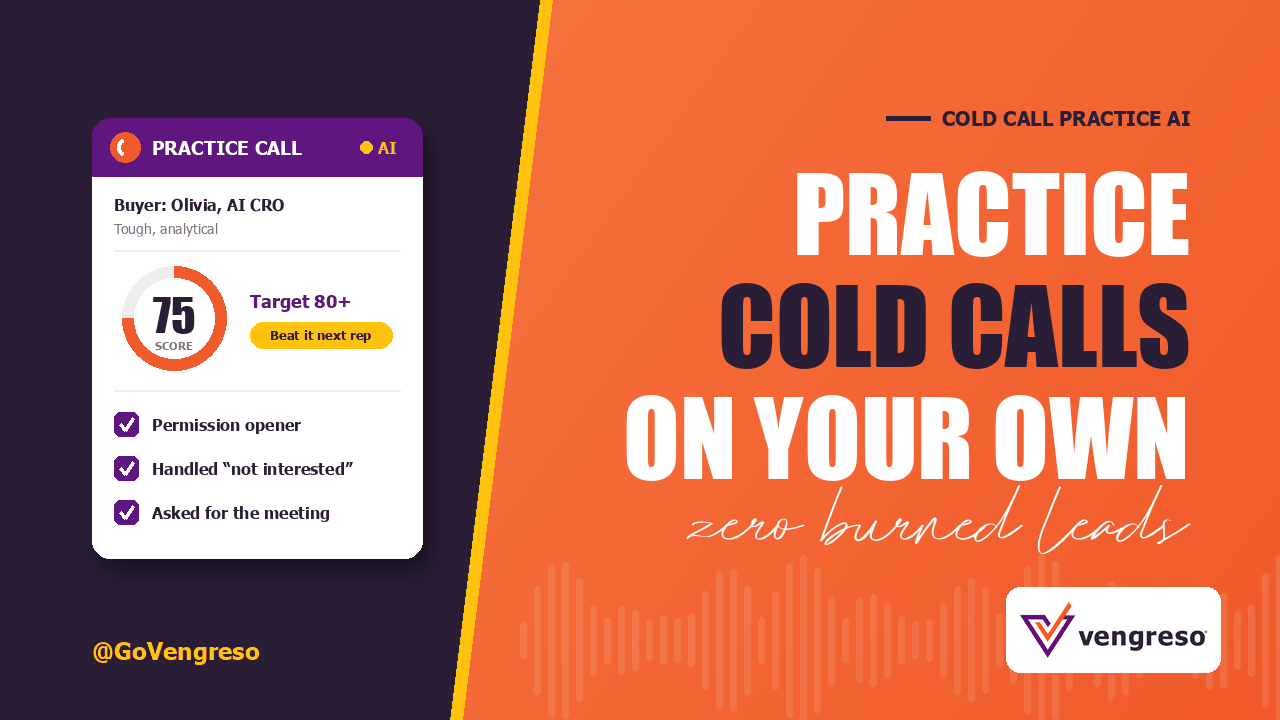
Mario Martinez Jr., Vengreso’s CEO, teaches cold calling to sales teams every month. When FlyMSG AI Sales Roleplay and Coaching launched, he ran a live cold call in front of a training room. The buyer was “Olivia,” an AI CRO with a tough, analytical personality.

He opened the way he teaches every rep: “I know you’re not expecting my call, and this is actually the first time I’ve tried reaching out to you. Do you mind if I take 30 seconds, or have I caught you at a bad time?”
Then he asked for the meeting right away, before he explained what Vengreso does. He told the room what would happen next before it happened: the buyer would stop him and say, “Wait, you haven’t even told me what you do.” Olivia said almost exactly that. Mario calls that objection the door, not a failure. The buyer just asked you a question, and now you get to answer it.
He walked through his reel-in: have you heard of us, one line of social proof, the problem CROs bring to Vengreso, and a question that handed Olivia the mic.
He still did not book the meeting. He asked four or five different ways. Olivia wanted security documents first. You’ve probably had a call end the same way, with a buyer who is curious but not ready to commit.
That is the whole case for practicing on an AI buyer. In Mario’s words: “The last thing you want to do is practice on a live body.” If a call can go sideways for someone who teaches cold calling for a living, it can go sideways for you. Better it happens in the simulator than on your best account.
Three habits Mario uses in every practice session
- Read the buyer card first. Each AI buyer comes with a personality and a short brief on how they want to be handled. A buyer who wants a clear plan and hates deep dives into minor features needs a different call than a friendly one. Read it before you dial.
- Chase a score, then beat it. Every practice call ends with a score. Write yours down, set a target a few points higher, and run the same scenario until you beat it. The coaching notes show what went well and what to fix, down to filler words and interruptions.
- Practice before you get rusty. Full-cycle reps stop prospecting at the end of the quarter to close deals. When the new quarter starts, they pick up the phone rusty. A few practice calls before the first live dial fix that.
Want to hear how another phone-first trainer builds the opener? Watch Mario and cold calling trainer Joe Pici break down the script on The Modern Selling Podcast.
How to Practice Cold Calls With FlyMSG AI Sales Roleplay and Coaching
FlyMSG AI Sales Roleplay and Coaching lets you rehearse cold calls and discovery calls with AI buyers who push back, then receive a score and coaching feedback after every call.

A typical practice session looks like this: you choose a cold calling scenario, start the roleplay, treat it like a real cold call, and then read your score and coaching notes right after. You know exactly where you stand before your next dial.
You build the scenario around your own product, ideal customer profile and the objections you actually hear. Auto-fill with AI can draft it from your company website, and you edit it from there. The coaching feedback points to what to fix, including whether you actually asked for the meeting.
Here is the part that matters if you are reading this as an individual sales rep. Every FlyMSG plan, including Free, includes a small practice allowance, and you can buy a roleplay plan for yourself at roleplay.vengreso.com, even if your company only uses the Free FlyMSG plan. You do not have to wait for budget approval. Companies that want this rolled out across sales teams typically go through FlyMSG Business Pro Enterprise or Business Pro Enterprise+, but you can get started on your own today.

What “Good” Feedback Looks Like (And How to Use It)
“Sound more confident” is not feedback. Useful detailed feedback is specific, objective, and tied to behaviors you can control.
Strong feedback measures something concrete: pace, question quality, objection handling, or next-step ask. It points to exact moments. It gives one clear suggestion. Good AI coaching tips follow this pattern. Sales coaching techniques that actually work always tie feedback to observable behavior.
Here is the difference. Vague: “You talk too much.” Sharper: “You spoke for 52 seconds without a pause. Try asking one question after your opener.” Or vague: “Weak phrasing on the close.” Sharper: “You ended with ‘maybe we could chat sometime’ instead of asking for a specific day and time.”
Feedback right after each practice call catches habits like filler words and talking over the buyer while the call is still fresh in your head. Your scores across multiple practice sessions show whether you are actually improving.
Translate each coaching note into a micro-goal for the next rep: “This time I will ask at least two open discovery questions before pitching” or “I will ask for the 15-minute meeting by the 90-second mark.” Pick one improvement per session, write it down, run the same scenario again, and see if the behavior changed. Ignore perfection.
Example Cold Calling Scripts and Scenarios You Can Practice Today
Here are practical lines in one common style many trainers teach. Test them in your very next AI roleplay session or live call block.

An opening line that earns permission: “Hi Mark, this is Jordan from Acme. I know you weren’t expecting my call. Can I get 20 seconds to tell you why I reached out?” A “not interested” objection handling response: “Totally fair. Most VPs I talk to say the same thing before they hear how we helped a similar revenue team [your real result, like ‘cut missed follow-ups in half’]. Would 15 minutes be worth exploring that?” A simple meeting ask: “Would Tuesday or Wednesday afternoon work for a quick 15-minute call?”
For mastering cold calling objections, practice these scenarios on repeat so you can handle objections more calmly and consistently: calling a VP of Sales who is behind quota, a COO cutting tools from the tech stack, a CFO who only wants the numbers, or a potential customer pushing back on a price objection. AI roleplay simulates real objections during cold calls, so you can face custom scenarios that match what you hear on real calls.
Practicing objection handling improves sales reps’ confidence. Run each objection until your answer comes out calm, then move to the next one. Customize each line with your product name, ICP title, and a specific problem your buyers mention in discovery calls. Then bring these same cold calling scripts into your AI roleplay session and tweak language after reading each feedback report.
Another Close to Practice: The WIIFM Close
The meeting ask above is one common close. Part 3 of the call I teach adds a reason to say yes. WIIFM means “what’s in it for me,” and every buyer is asking it.
“Even if you decide not to go any further after our next meeting, you’ll walk away with a framework to assess where you are today, and we’ll stay a resource for you. Can we schedule the next meeting now for Thursday at 3 PM?”
Why it works: It takes the risk out of yes. The buyer isn’t agreeing to buy. They’re agreeing to get something useful from one meeting.
Practice the Show-Up, Too
Part 4 is the up-front contract, and it protects the meeting you just booked. Before you hang up, ask three things: “Will you accept the calendar invite so I know you got it?” “Is there any reason you won’t be able to make it?” “If something comes up, can we agree now to work together to reschedule?”
Why it works: Accepting the invite is a small yes that locks in the big one. If they miss the meeting, you already have their agreement to reschedule, so your follow-up isn’t pushy. Scripts often stop at the meeting ask. Practice these three lines too, so they come out naturally on live calls.
Load both styles into your AI roleplay, the common one above and the four-part order, and see which one books more meetings with your buyers. To see how the four parts fit together in a live call, read our cold calling guide.
How to Keep Your Cold Call Practice Consistent (Without Burning Out)
Back-to-back meetings, shifting quotas, and tough days of live cold calls make it easy to skip practice. Set a small habit you will not skip: a few focused practice reps on the one skill you are working on this week. Fit them in before your first dial or between call blocks.
Track streaks and small wins. “First week I stopped freezing on objections.” “Second week my opener sounded smoother.” Mix your focus through the week: Monday for openers, Tuesday for objection handling, Wednesday for discovery questions, Thursday for closing, Friday for reviewing your scores and notes.
The goal is not grinding for hours. It is building a habit of short, intense, repeatable practice that shows up in your live cold calling performance. Frequency is what drives real learning and better performance over time.

FAQ: Practicing Cold Calls With AI
Here are quick answers to common questions about AI cold call practice.
How many AI cold call practices should I do before calling real prospects?
There is no magic number. Run a few focused practice calls each week on the part of the call that feels weakest, and keep live dialing alongside them. The key signal to move into heavier live calling is when your opener, objection handling, and meeting ask feel smooth instead of forced. Watch your practice scores. When they hold steady across several sessions, you are ready.
Can AI roleplay replace live cold calling experience?
No. AI roleplay is meant to prepare you for real calls, not replace them. It lets you make early mistakes in a safe space and build confidence before bringing improved skills into real conversations with real prospects. Think of it as the practice session before the real thing.
What if my company does not buy any sales training tools?
You can still practice on your own. Buy a personal plan for FlyMSG AI Sales Roleplay and Coaching at roleplay.vengreso.com without going through procurement. Invite your manager later if they want team-wide AI roleplay through Business Pro Enterprise or Business Pro Enterprise+.
How do I know if AI cold call feedback is accurate for my industry?
Sanity-check AI feedback against what you hear from real buyers and any experienced rep you trust. Keep what matches reality. Strong fundamentals like clear openers, sharp questions, and direct meeting asks work across every industry. If your difficulty level or jargon is unique, customize scenarios to match.
What should I do if I feel more nervous on AI calls than real ones?
Treat AI sessions like gym reps, not exams. Lower the pressure by setting tiny goals for each run. Remind yourself that “bad” reps are expected and useful because they expose habits you can fix before your next real cold call. Start with one micro-skill and build from there.
Next Step: Turn Practice Into Meetings
Follow a simple routine. Use AI roleplay as your daily sparring partner. Focus on clear, specific feedback. You will gradually master cold calling fundamentals and book more meetings. You do not need permission to get better.