
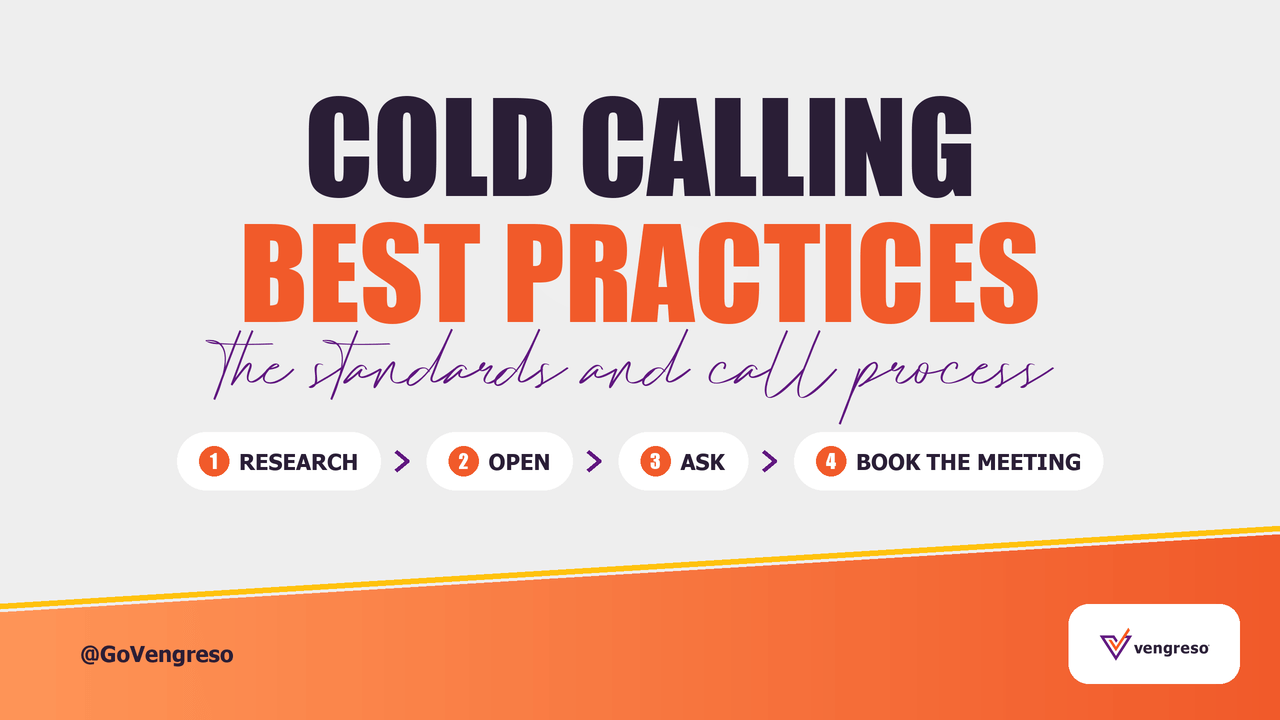

Cold calling best practices come down to running the same structured process on every dial: research the prospect, open with a relevant reason for the call, ask questions that reveal fit, make a specific meeting ask, handle the first objection with a practiced response, and log clean notes before you move on. Cold calling remains a vital method for generating sales pipelines, and the teams that win treat it as a repeatable system, not a collection of random tricks.
This guide walks you step by step through a complete cold calling process you and your sales team can run on every call. You will set standards for research, call blocks, openers, handling the first objection, voicemails, follow-ups, and CRM notes so your cold call performance becomes consistent and repeatable.
Key Takeaways
- Cold calling in B2B sales is about selling the meeting, not the product. Every call should follow the same structure: opener, reason for the call, questions, and a clear ask for time.
- Pre-call research standards, time-blocked calling sessions, and a defined first-objection play keep you from ad-libbing your way through phone calls. Agree on these as a team.
- Log quick CRM notes after every call, track a few simple metrics (dials, connects, conversations, meetings booked), and review daily so you spot drift before it costs you pipeline.
- Practicing your opener and objection handling with FlyMSG AI Sales Roleplay and Coaching before live dials makes every part of the process easier and faster.
- Combining cold calls with cold emails and social touches as a multi-channel approach increases your effectiveness and helps you become a familiar name before the prospect ever picks up.
Cold Calling in B2B Sales: What “Good” Looks Like
Cold calling means calling net-new potential customers to start conversations that lead to meetings. An effective cold call earns interest and advances the prospect to the next stage, not a first-call close. Not to run a 20-minute discovery. You are selling time for a next step. That is it.
Top sales teams treat cold calling as a repeatable process with shared standards. They do not hand a new rep a phone and say “figure it out.” They document the opener, the questions, the objection responses, and the follow-up cadence. Then they drill it, because cold callers are there to create momentum, not finish the whole sales process on one call.
Cold calling relies on strong preparation and a clear structure. Without that, you are guessing. And buyers notice: a RAIN Group Center for Sales Research study, reported by CustomerThink, found that 58% of sales meetings are not valuable to buyers. Prospecting should focus on solving problems rather than pitching products, because the prospect does not care about your features during the initial cold call. They care whether you understand their world.
This article walks in order from before the call, through the live conversation, to post-call work. Follow it like a checklist on every dial. Cold calling techniques that actually work are about relevance, control, and consistency, not sounding like a robot reading a rigid sales script word for word.
Managers: your job is to define and enforce these best practices so every cold call sounds similar regardless of who on the team is dialing. That is how you cut rep ramp time and build a predictable outbound sales engine.
Team Cold Call Standards Checklist (One Page You Can Copy)
Print this. Save it next to your dialer. Share it with every new hire.

- Target list is segmented by ICP and meets minimum data quality
- 60 seconds of research per prospect completed before dialing
- Call blocks scheduled and protected on the calendar
- Opener and reason for the call defined and practiced
- Primary and backup meeting ask prepared (specific date, time, duration)
- Standard first-objection response chosen and rehearsed
- Voicemail structure agreed on (when to leave, what to say)
- Follow-up rule documented (call cadence, cold emails, LinkedIn touches)
- CRM fields to update after every call: outcome, interest level, key notes, next action with date
- Metrics tracked daily: dials, connects, conversations, meetings booked from cold calls
Managers: this checklist becomes your standard operating procedure for onboarding and ongoing coaching. When a rep struggles, walk the checklist and find the broken step. Do not guess.
Define Your Target and List Before You Ever Dial
Random cold calls are guessing. List quality drives cold call performance more than any clever line you will ever write.
Cold calling strategies include what some teams call the Rifle and Shotgun approaches: rifle means fewer, deeply researched calls to high-value targets; shotgun means higher volume to a broader list. Most B2B sales teams blend both, but either way the list must be clean.
Standards for your list:
- Segment by role, industry, company size, and geography. Tag each list clearly in the CRM so you can analyze results later.
- Confirm contact info. Direct lines and mobile numbers beat generic switchboard numbers every time. Some teams also find that a local phone number helps more prospects pick up, so test it on your own lists.
- Connect your list to your ICP. Example: “US-based SaaS companies, 50-500 employees, VP of Sales or Head of SDR.”
- Document list sources (inbound database, intent tools, events, self-sourced) and set a minimum threshold for data cleanliness before any dial block starts.
Belkins analyzed more than 175,000 B2B dials and found that about 10% of dials connect, but about 25% of prospects eventually pick up when you call them across multiple attempts. That is a list strategy issue, not just “keep calling.” Good lists also make it easier to reuse a focused call script across an entire segment because the prospects share similar pain points and priorities.
Pre-Call Research Standards (What You Must Know in 60-90 Seconds)
Pre-call research should be timed and standardized. Not 10-minute deep dives that kill your call volume.
Here is the research checklist every rep should run before a cold call:
- Job title and decision-making scope (are they the right person?)
- Company location and market vertical
- What do they sell, and who do they sell to?
- One recent company event: funding, product launch, acquisition, leadership change, or news articles mentioning them. These are trigger events for outreach.
- One or two things from the prospect’s LinkedIn profile: a post, a comment, a shared connection
Deep research makes personalization possible, and personalization is the price of admission on a cold call. Researching prospects helps because tailored insights let your opener command respect by showing you did your homework, so your questions and value statements feel relevant instead of generic.
Cold calls should reference recent research or specific challenges the prospect is facing. That is the difference between a cold call that earns 30 more seconds and one that gets a click.
Managers: set research standards by role and segment. More research for C-suite targets. Less for manager-level when doing higher-volume cold calling. But never zero.
Build a Simple Cold Calling Script Framework (Not a Robot Script)
A cold calling script framework is not a word-for-word script. It is a structure that keeps you on track while letting you sound like a human being.
Your framework covers these parts:
- Opener: your name, company name, and a pattern-interrupt
- Reason for the call: why you, why now, tied to their world
- Permission to continue: “Do you have 30 seconds?”
- One or two discovery questions: to assess fit and priority
- Short value statement: outcome-focused, not a feature dump
- Specific meeting ask: date, time, duration
- Clean exit: if they say no, leave the door open for a future conversation
Effective cold calling scripts should be tailored to the prospect’s industry. Build one or two standard call scripts per persona, for example VP of Sales versus Revenue Operations, and store them in a shared library or text expander so any rep can pull them up fast.
What reps must not do: long product sales pitches, vague asks like “maybe we can connect sometime,” or leading with your company name and a feature list. Establish a specific call-to-action to guide the conversation’s next steps. Cold calling can increase prospects, demos, and sales opportunities, but only when the call has a clear ask.
Practice these frameworks in FlyMSG AI Sales Roleplay and Coaching before you use them live. You can test your opener and talk track with AI buyers who push back, then get a score and coaching feedback so you walk into real phone calls with confidence.
Practice Before Live Dials: Roleplay, Recordings and FlyMSG
The first time you say a new cold call script should never be to a real prospect. Practice is a non-negotiable best practice.
Practicing cold calling skills in a safe environment builds confidence. FlyMSG AI Sales Roleplay and Coaching lets you rehearse cold calls with 16 AI buyer personalities who respond like real prospects. They interrupt you. They object. They push back. After every session, you get a score and coaching feedback on your opener, clarity, and objection handling.
Managers can customize scorecards and build shared roleplay scenarios that mirror the team’s real objections, products, and buyer personas. That turns practice into a training ground, not a guessing game.
Suggested weekly rhythm:
- 10 minutes of AI roleplay before each morning’s call block
- Peer roleplays in team meetings, focusing on the first objection
- Review call recordings together to spot where reps drift off framework
A fool with a tool is still a fool. Practice should follow the team’s agreed standards, not replace them. FlyMSG is the accelerator. The standards are the engine.
Structure of a High-Quality Cold Call
Here is the full anatomy of a cold call from hello to a clear next step.

- Pattern-interrupt opener: say your name, company, break the expected rhythm
- Clear reason for the call: one sentence tied to their role or industry
- Permission to continue: “Do you have 30 seconds?” earns respect
- One or two discovery questions: reveal priority and fit
- Brief tailored value statement: outcome they care about, not your features
- Specific meeting ask: “Would next Tuesday at 2 p.m. work for a 20-minute Zoom?”
- Clean exit: if it is a no, be professional and protect the relationship
Most cold calls are short. In Allo’s analysis of 72,339 cold calls, the average connected call lasted about 60 seconds, and a third ended within 30 seconds. That is why the opener carries so much weight, and why you are not running a full discovery. You are earning the right to a next step. When the prospect stays engaged, aim to reach the ask in two to three minutes, with total calls usually under five minutes for net-new prospects.
Managers: document a default structure and use it in onboarding and weekly call reviews. When a rep can self-score each moment of a cold call, they improve faster.
Strong Openers and Clear Reasons for the Call
The first five to 10 seconds decide everything. Your prospect decides fast whether to stay or hang up. Spark interest immediately or lose the chance.
Cold calls should open with a relevant reason for calling. Say your full name and company, then immediately state why you are calling, tied to the prospect’s business or role. Personalized openers increase engagement during cold calls, and using a mutual connection or prior contact can warm up cold calls significantly. That is practical cold calling advice: earn attention through relevance instead of leading with a generic pitch.
Example structures:
- “Hi Jane, this is Alex Carter with Acme. The reason for my call is that I work with VPs of Sales at SaaS companies who are trying to cut ramp time in half, and I saw your team just posted five new AE roles.”
- “Hi Mark, this is Alex Carter with Acme. I noticed your company just closed a Series B. I wanted to start a real conversation about how sales leaders in your space build pipeline faster after a raise.”
- “Hi Sarah, this is Alex Carter. A colleague of yours, Tom, suggested I reach out because you are focused on outbound strategy this quarter.”
Agree on one or two standard openers as a team. Measure cold calling performance by opener type to see which earns more conversations and gets the prospect’s attention. Reps can practice only the first 30 seconds in FlyMSG AI Sales Roleplay and Coaching until they can deliver it smoothly without sounding rushed or reading.
Another Way to Open: Vengreso’s 4-Part Cold Call
The openers above lead with research, and they work. In our trainings, we teach a different structure in four parts. Try both and keep the one that books more meetings for your team. Here is Part 1.
Part 1: The opening and the purpose. Say who you are and where you’re calling from, admit the call is unexpected, and ask for 30 seconds or whether it’s a bad time. Then state your purpose plainly: you’re calling to get time on their calendar, with a specific day and time. Hold the pitch until the prospect asks, “What do you do?”

Why it works: the prospect decides in the first 15 seconds whether to keep listening. When I admit the call is unexpected, it breaks the pattern they’re braced for, and they relax instead of reaching for the hang-up button. And when they ask “What do you do?”, they just invited my pitch.
Questions, Listening and Selling the Meeting (Not the Product)
The goal of every sales cold call is to sell time for a next step and book high-value appointments. Not to run full discovery. Not to deliver sales pitches. Sell the meeting.
Use open-ended questions that engage prospects during calls and reveal fit, then adjust your next question based on how the prospect responds:
- “What is your biggest challenge with [pipeline, outbound, ramp time] right now?”
- “How are you currently handling [specific process tied to your solution]?”
- “What would need to change for you to hit your number this quarter?”
Listen more than you talk. Take light notes. Then mirror back what you heard: “It sounds like your team is spending too much time on manual prospecting and not enough on real conversations.” After the mirror, deliver a short, outcome-focused value proposition, not a feature list.
Use follow up questions to uncover the real challenge before you ask for the meeting.
Vengreso’s Part 2: The personal. In our 4-part cold call, once the prospect asks what you do, give a short referential statement (for example, “CMOs turn to us when…”), ask one compelling question about a tool, process or system they have in place, and then ask what we call the Big 3 of B2B: who they use today, when that contract started or ends, and how many users they have or how much it costs. Those three answers give you the competitor, the buying window and the size of the deal in under a minute.
The ask is a micro-commitment. Not “let’s follow up sometime.” Instead: “Would next Wednesday at 10 a.m. work for a quick conversation, 20 minutes on Zoom? I will send a calendar invite right now.” Successful cold calls focus on understanding needs and earning the next step, especially when your outreach is reinforced by email or social touches. Confirm follow-up dates during the call to ensure accountability. Have your calendar handy.
Vengreso’s Part 3: The WIIFM close. Before you ask for the time, tell the prospect what’s in it for them even if they go no further than that one meeting. Then ask for a specific day and time. A reason to show up beats a polite yes every time.
Managers: record and review sample sales calls weekly to check that reps are not slipping into long monologues about features.
Handling the First Objection as a Standard Play
Every cold call hits at least one objection. “Not interested.” “Too busy.” “Send me an email.” “We are all set.” The team must agree on standard responses so nobody is improvising under pressure. Sales objections are normal in outbound sales and should be treated as data, not a personal attack.
Here is a simple, repeatable pattern:
- Pause: do not talk over the objection
- Empathize: “I completely understand”
- Clarify: ask a short follow up question: “What specifically makes you say that?”
- Reposition value: tie back to their world
- Re-ask: for a small next step
Empathetic objection handling lowers resistance during cold calls. Empathy in cold calling can improve rapport with prospects, and acknowledging objections can keep hesitant prospects engaged instead of defensive.
Here is the part most sales reps miss: an objection means the prospect is thinking. That is better than silence. Sales reps should prepare responses for common objections in advance so they do not freeze.
Three to five common cold calling objections and one approved response each, documented and drilled, will cover most of what you hear. Managers can use FlyMSG AI Sales Roleplay and Coaching scenarios to drill the first objection reps face on most calls.
If an objection shows true no-fit, exit gracefully. Protect the prospect’s time and a potential future conversation. Not every call is a fit. That is fine.
Voicemails and Follow-Up Rules
Many cold calls in B2B sales will hit voicemail. Treat voicemails as planned touchpoints, not afterthoughts. Leaving effective voicemails can improve follow-up success and keep you top of mind.
Voicemail structure (under 20 seconds):
- Start with the reason for the call
- Add one specific point of value
- Say your name and number twice
- Done
Standards:
- Leave voicemails on the first and third attempt only, not every ring
- Pair each voicemail with a cold email that references the voicemail and adds one more piece of value
- Personalized LinkedIn touches can reinforce recall after calls and make you a familiar name
Follow-up calls should occur within five to eight attempts before you switch a prospect to nurture or disqualify. Log voicemail dispositions in the CRM so managers can see how many calls hit voicemail and how the strategy affects response rates.
Call Blocks, Timing and Daily Rhythm
Batching calls into focused 60 to 90-minute blocks makes a big difference. You get in flow. You stop multitasking. Your cold call performance goes up.
In Allo’s analysis of 72,339 cold calls, calls placed between 11 a.m. and 4 p.m. in the prospect’s local time reached a live person 27% to 28% of the time, and calls before 10 a.m. rarely turned into real conversations. The day of the week mattered much less than the hour, and Monday had the best conversation rate. Protect a midday block and test the rest against your own results.
Standards per block:

- Aim for a realistic number of dials that still allows for research, notes, and follow-up. The median SDR makes about 44 dials per day, and reps on phone-centric teams make about 56, according to the Bridge Group’s 2025 survey of 351 B2B companies, as reported by MRR Nerds.
- Do not multitask during a call block. No email. No Slack. Phone interactions only.
- Warm up before the first block. Two FlyMSG AI Sales Roleplay calls gets your voice and tone ready.
Managers: protect call blocks on team calendars. Do not book internal meetings over them. Cold calling is core outbound sales activity, not filler work.
Example of a Simple Call Block Schedule
Here is a daily schedule an SDR or BDR can mirror in their own calendar. Adjust for your time zone and meetings.

| Time | Activity |
|---|---|
| 8:30-8:40 | Warm-up: roleplay opener, review daily goals |
| 8:40-10:10 | Call block 1 (focused dials, no multitasking) |
| 10:10-10:30 | Admin: the cold calling work after live dials, including CRM notes and follow-up prep |
| 11:00-12:30 | Call block 2 |
| 12:30-1:00 | Lunch |
| 1:00-2:30 | Call block 3 |
| 3:30-4:30 | Follow-up calls, callbacks, cold emails, LinkedIn |
| 4:30-4:45 | Review metrics, prepare tomorrow’s list |
AEs with heavier meeting loads can reduce to one or two blocks, but still need at least one daily cold call block to keep pipeline alive. You can learn more about structuring your day for maximum productivity.
Managers: consider a team-wide “power hour” where everyone calls at the same time. Energy is contagious.
CRM Notes, Call Outcomes and Follow-Up Cadence
Clean CRM data is part of cold calling best practices because it makes future calls, handoffs, and reporting possible. No notes means no memory. No memory means wasted dials.
Log detailed notes in your CRM after each call. Minimum fields to update immediately:
- Call outcome: no answer, voicemail, live conversation, wrong person, rejected
- Interest level: cold, warm leads, hot
- Key notes: what you learned (pain, current tools, priorities, decision makers involved)
- Next action with date: send email, schedule follow-up call, LinkedIn message, disqualify
Define standard call dispositions as a team. Set a simple follow-up cadence: how many times to call back, when to switch to nurture, when to disqualify. Use a multi-channel approach for follow-ups to increase visibility, combining phone calls with cold emails and social touches.
After a positive conversation, follow up same day. Send an email recap and a calendar invite to lock in momentum. Modern cold calling combines calls with emails and social media for maximum impact. Tracking and analyzing call outcomes can improve future cold calling success.
Vengreso’s Part 4: Getting them to show. The last part of our 4-part cold call happens before you hang up. Confirm the calendar invite, ask whether anything could get in the way of the meeting, and get agreement to reschedule together if something comes up. A meeting that never happens is worth nothing, and that up-front agreement turns a likely no-show into a new date.
Managers: audit random call records each week. Make sure notes and next steps are logged consistently across all reps on the sales team.
Cold Call Metrics to Track as a Team
Keep metrics simple. Track a short list of numbers every SDR, BDR, and AE can understand and own daily.
- Total dials: volume of outbound attempts
- Connects: how many times a live human picked up
- Conversations: connects that went past the opener (usually 1+ minute with decision makers)
- Meetings booked: qualified meetings set from conversations
- Meetings held: show rate on those bookings
Tracking metrics like connect rates and decision-maker rates reveals performance insights you cannot see from dials alone. Compare by segment, by call script, and by list source. Which cold calling strategies are working? Which talk tracks earn more calls that move the conversation forward?
Reps should do a quick self-review of their own numbers at the end of each day. Where are you light? Adjust tomorrow’s call plan. Managers can pair these metrics with qualitative feedback from call recordings and FlyMSG AI Sales Roleplay scores to build a full picture of cold call performance.

Next Steps to Make These Cold Calling Standards Real
Do not try to change everything at once. Pick the first standard, agree on it as a team, and run it for two weeks.
First week rollout plan:
- Agree on the cold call script framework for your top persona
- Book shared call blocks on the team calendar
- Set CRM dispositions and the follow-up cadence
- Choose the first objection to practice and drill it daily
Make roleplay and practice part of the culture. FlyMSG AI Sales Roleplay and Coaching is the default place to rehearse before live dials, and it has a free plan so every rep can start practicing today.
Cold calling creates immediate human connections with potential customers. No email, no ad, no chatbot gives you that. The sales game still runs on the phone. Build the process. Run the process. Trust the process.
FAQ
How many cold calls should a B2B rep aim for each day?
It depends on your role and deal size. The Bridge Group’s 2025 survey put the median SDR at 44 dials a day, and 56 on phone-centric teams, which still leaves time for research, notes, and follow-up. AEs who close deals can still run a lean daily cold call block of 20 to 30 dials and keep warm calling and outbound strategy alive. The key is that more calls only help if each one follows the process. Volume without quality is just noise.
What is the best time of day to make cold calls?
In Allo’s data, calls between 11 a.m. and 4 p.m. in the prospect’s local time zone connected most often, and calls before 10 a.m. rarely turned into conversations. The day of the week mattered less, with Monday showing the best conversation rate. Track your own results by time block to find your team’s “power hours.”
How long should a successful cold call last?
Most first cold calls are short. In Allo’s analysis, the average connected cold call lasted about 60 seconds, and a third ended within 30 seconds. You are not running full discovery. You are booking a meeting. If you hit three to five minutes and the prospect is engaged, great. But do not force small talk or drag it out. Keep the short call focused.
How much research should I do before each cold call?
Standard is 60 to 90 seconds of focused research per prospect for most lists. Check their title, company news, and one LinkedIn insight. For high-value strategic accounts or executive-level targets, spend a bit more. The goal is a relevant insight that makes your opener feel personal, not a 10-minute deep dive that kills your dial count.
Should I stick to one cold calling script or customize every call?
Start from one agreed framework per persona. Then customize a few key lines based on your research so the prospect hears something relevant to their world. You should never reinvent the best cold calling scripts from scratch on every call. That is how reps burn time and lose consistency. Use your own words within the framework and you will sound like a real human, not a cold caller reading off a screen. For more ideas, check out these cold calling tips to book more meetings.