

Cold calling coaching is the weekly practice of listening to your reps’ real calls, scoring observable behaviors, giving feedback they can use on the very next dial, and running practice drills that build skill between sessions. It is not a one-off training day. It is your most direct lever for turning the same dial volume into more booked meetings across your whole team.
This guide gives you everything you need: a copy-paste scorecard, a weekly coaching session agenda, example feedback lines, practice drill formats, and the metrics that prove coaching is working.
Key Takeaways
- Listen, score, coach, practice, measure. Effective cold call coaching follows a repeatable loop, not a random conversation about “doing better.”
- Coach behaviors you can hear. Your scorecard should measure observable actions on real calls (opener, discovery questions, objection handling, meeting ask), not vague traits like “confidence.”
- One standard scorecard, one weekly rhythm. When every manager uses the same scorecard and the same coaching cadence, you can compare performance across the team and spot patterns fast.
- Practice before live dials. Reps who role play objections and openers away from real prospects perform better when it counts. Tools like FlyMSG AI Sales Roleplay and Coaching let reps rehearse with AI buyers that push back, get a score, and read coaching feedback, and you see who is actually practicing.
- Tie coaching to meetings, not feelings. Track connect-to-meeting rate, talk time, and objections handled per connect. If those numbers move, coaching is working.
Why Cold Call Coaching Is Your Fastest Revenue Lever
Most cold calls still fail. Cognism’s 2025 State of Cold Calling report put the average success rate at 2.3%, counting a cold call that turned into a warm lead. That number sounds brutal. But here is what most sales leaders miss: small improvements in conversion rate create massive pipeline gains when you multiply them across 10, 50, or 100 reps.
Buyers still say yes to the right call. A RAIN Group Center for Sales Research study of 488 buyers, reported by CustomerThink, found that 82% of buyers accept meetings with sellers who proactively reach out to them. The channel works. The question is whether your salespeople are good enough at it.
CallingAgency’s 2026 benchmarks put the average dial-to-meeting rate at 2% to 3% and top performers at 5% to 8% or more. Moving a team from a 2% to a 5% dial-to-meeting rate means you get 2.5x more meetings from the same phone calls. No new headcount. No new tools. Just better coaching.

Effective cold calling coaching transforms outbound calling into a predictable revenue driver. It is not a once-a-year training program. It is your weekly habit of listening to real calls and giving actionable tips your reps can use on the next dial.
You control this system. What gets reviewed, what gets scored, how often you meet with cold callers. That is the fastest path to more meetings.
Define What An Effective Cold Call Looks Like For Your Team
You cannot coach well without a clear definition of what a “good” cold call looks like for your product, your ICP, and your sales team. Write it down.
Start with the outcomes you care about: a booked meeting, a qualified next step, or a referral to the right person. Not just “nice conversation.”
Then define the behaviors every rep must hit:
- Strong opener with permission. A short, honest permission ask lowers the prospect’s guard. In our cold call training, we teach that the first 15 seconds decide whether the prospect stays on the line.
- Clear reason for the call tied to the prospect’s role or pain points, not a generic pitch. The opening message must establish relevance quickly to engage prospects.
- Two to three discovery questions that uncover a real problem, budget reality, or priority.
- A value statement that connects your product to the prospect’s specific situation.
- A clear meeting ask with a specific date or time, not “would you like more info?”
Cold calling requires communication and persuasion skills, but also a calm and conversational tone rather than a high-pressure pitch. Reps need to conduct research before making calls to improve success. That means your cold calling strategies, your sales methodology, and your cold call script all need to align.
Document this definition on one page. It becomes the north star for your scorecards, your coaching, and your role play drills.
Another Way to Define It: Vengreso’s 4-Part Cold Call
The behaviors above are what many trainers teach, and they work. In our trainings, we teach a different structure. Coach both and see which one books more meetings for your team. Here is how the first two parts of our 4-part cold call change what you listen for.
Part 1: The opening and the purpose. The rep says who they are and where they’re calling from, admits the call is unexpected, and asks for 30 seconds or whether it’s a bad time. Then they state the purpose plainly: to get time on the calendar, with a specific day and time. They hold the pitch until the prospect asks, “What do you do?”
Why it works: cold calls are short, and the prospect decides in the first 15 seconds whether to keep listening. Admitting the call is unexpected is a pattern interrupt. It relaxes the buyer instead of putting them on guard. When the prospect asks “What do you do?”, they just invited your pitch.
Part 2: The personal. Once the prospect asks, the rep gives a short referential statement (for example, “CMOs turn to us when…”), asks one compelling question about a tool, process or system the prospect has in place, and then asks the Big 3 of B2B: who they use today, when that contract started or ends, and how many users or how much it costs.
Why it works: those three questions give you the competitor, the buying window and the size of the deal in under a minute. When you coach Part 2, listen for whether the rep asked all three before asking for the meeting.
Build A Simple Cold Call Coaching Scorecard
A shared scorecard keeps coaching objective. It helps different managers coach cold callers the same way, and it gives reps a clear picture of what “good” looks like. Our guide to building a sales scorecard covers the bigger picture beyond cold calls.
Your scorecard should measure only observable behaviors on a sales call. Things you can hear. Not “was confident” but “used a clear opener and asked for permission to continue.”
Each item needs three elements:
- What to listen for
- A simple score: Yes, Partial, or No
- A space for call-specific notes and a suggested next drill
You can adapt the scorecard to frameworks like BANT or MEDDIC by mapping your discovery questions and checkpoints to those elements. If your process says “identify budget authority,” add a scorecard row for it.
Use the scorecard in both 1:1 coaching and in regular team meetings where the group reviews calls together.
If your team runs our 4-part cold call, add rows for the last two parts. Part 3, the WIIFM close: did the rep tell the prospect what they gain even if they go no further than the next meeting, then ask for a specific time? Part 4, getting them to show: did the rep confirm the calendar invite, ask whether anything could get in the way, and get agreement to reschedule together if something comes up? A meeting that never happens is worth nothing, and that up-front agreement turns a likely no-show into a new date.
Cold Call Review Scorecard Template (Copy-Paste)
Here is a simple scorecard you can copy and use today. Keep each cell short so you can fill it live while listening to call recordings or during live monitoring.
| Behavior | What to Listen For | Observed? (Yes / Partial / No) | Notes / Next Drill |
|---|---|---|---|
| Opener and permission to continue | Clear company name and rep name, asks “Do you have 30 seconds?” or similar | ||
| Reason for the cold call tied to prospect role | Connects the call to prospect’s industry, title, or a specific question about their business | ||
| Discovery questions (2-3) | Open questions about pain points, priorities, or current process | ||
| Talk time balance | Prospect speaks at least 40% of the entire cold call; rep does not monologue | ||
| Objection handling | Acknowledges the objection, asks a clarifying follow up, responds with value | ||
| Clear next step / meeting ask | Proposes a specific meeting date and time, not a vague “let me send you info” |
Attach this scorecard to each reviewed cold call in your CRM or coaching folder. Over time, you will see exactly where each rep is improving and where they are stuck.
How To Listen To Real Calls Like A Coach, Not A Critic
Your job is to find one or two coachable behaviors per rep per session. Not to play gotcha. Not to count mistakes.
Before you listen, know the context:
- What account was the rep calling?
- What was the cold call goal (book a meeting, reach the right contact)?
- Where is this rep in their ramp time?
Then use two listening passes:
- First pass for structure. Did the rep hit opener, reason for calling, discovery, and ask?
- Second pass for tone, pacing, and objection handling. Was the rep warm? Did they actively listen or just push through?
Ignore things outside the rep’s control, like bad data, a wrong number, or a gatekeeper who will not connect. Focus on how the rep reacts when the right person answers.

Reviewing recorded calls is one of the best uses of your coaching time. Play back 30 to 90 seconds from the key moment of the cold call so reps hear their own voice and self-diagnose. That creates a breakthrough most people never get from a lecture.
Weekly Cold Call Coaching Session Agenda
Every SDR, BDR, and AE who makes phone calls should have a 30 to 45 minute weekly coaching session with their manager. Here is the agenda:
- Review prior coaching focus and wins (5 min). What did the rep commit to last week? What happened?
- Listen to 1-2 recorded cold calls together (20 min). Score them using the scorecard. Pause, rewind, discuss.
- Agree on 1-2 behavior changes (5-10 min). Pick one specific skill to focus on. Focus each session on one skill so it sticks.
- Assign practice drills (5 min). Give the rep a clear assignment: “Practice the new opener 5 times before your next calling block.”

End with a specific commitment. “On your next 20 cold calls, we are only focused on tightening your opener and your first discovery question.” Write it down.
For teams of 10 to 100 reps, also run a short weekly group session where 3 to 5 reps bring their best call and their toughest call for peer feedback. This creates a supportive environment where the whole team learns from real examples.
How To Give Cold Call Feedback Reps Can Use On The Next Dial
“Sound more confident” is not feedback. It is a wish. Your reps cannot act on it.
Here are the principles that make cold call feedback actually work:
- Be specific. Anchor feedback to a real call moment. “At 0:42 you said X, and the prospect paused. Here is what to try instead.”
- Focus on one behavior. Do not dump five corrections at once. Pick the one that will move the needle most.
- Tie it to the next 10-20 calls. “Try this new version of your opener on your next calling block and let me know what happens.”
- Balance positive and constructive. Reinforce what the rep already does well so they build on it.
Real-time feedback is crucial for effective cold call coaching. Use the “play the tape, then coach” approach: play the moment a prospect objected or hesitated, walk through what a stronger response could sound like, then let the rep try it out loud right there.
Write the agreed next step in a few words: “practice new opener” or “pause 3 seconds after objections.” Both you and the rep track it at the next session.
For more sales coaching techniques, keep the focus on behaviors, not personality.
Example Feedback Lines: What To Say And What Not To Say
Copy and adapt these. They are paired so you see the wrong way and the best approach side by side.
On the opener:
- Not this: “You sound nervous.”
- Say this: “Let’s tighten your opener so it feels more natural. Try this specific line three times before your next cold call block.”
On objection handling:
- Not this: “Handle cold call objections better.”
- Say this: “When they say ‘not interested,’ pause, acknowledge, and ask one follow up question like: ‘Totally fair. Can I ask, what are you doing today to handle [pain point]?'”
On talk time and pacing:
- Not this: “You talk too much.”
- Say this: “Aim for a 60/40 prospect-to-rep talk time. Try asking this extra question and then staying silent for 3 seconds.”
On the value statement:
- Not this: “You’re just not a good cold caller.”
- Say this: “Your value statement got long at the 30-second mark. Cut it to one sentence for the next 20 cold calls and see what happens.”
Cold calling success requires a calm and conversational tone. Help your reps find that tone by giving them new techniques to practice, not personal judgments to absorb.
Designing Cold Call Practice Drills And Role Play That Feel Real
Reps should practice cold calls away from real prospects first, then take those behaviors live on the next calling block. Coaching cold calling involves breaking high-anxiety interactions into manageable habits. That is what drills do. For reps who want a self-study plan between sessions, share our cold calling training guide.
Three drill formats you can run in 10 to 15 minutes:
- Rapid-fire objection handling. Read a common objection out loud. Rep responds three different ways. Move to the next objection. Repeat.
- Opener drills. Rep delivers their opener 5 times in a row, tweaking one word each time until it feels natural.
- Discovery question ladders. Rep practices asking three questions in sequence to uncover business impact, without pitching.

Base your role play on real calls and real objections from your team. Transcribe an actual objection from a recent cold call and ask reps to respond three different ways. Role-playing realistic scenarios is crucial for reinforcing cold calling skills. New to the format? Our guide to what AI sales roleplay is explains how it works.
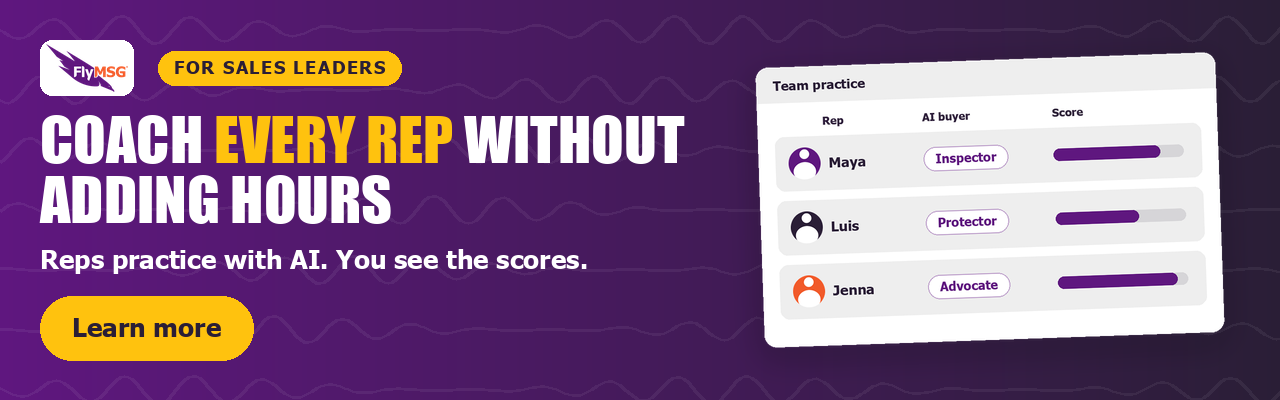
FlyMSG AI Sales Roleplay and Coaching works as a cold call simulator here. Reps practice with AI buyers that push back, get a score after every session, and read AI coaching feedback before their next live calls. Managers can customize scorecards and build scenarios around their own products and common objections. Team reporting shows who is practicing and who is not.
Rejection is a normal part of cold calling. Drills build the resilience to hear no and pick up the phone again.
Assign 2 to 3 specific drills per week. Track who completes them. Then listen for those exact skills in real cold calls recorded later that week.
Using Real Calls As Your Coaching Library
Build a library of call recordings from your own team, tagged by skill: openers, objections, meeting asks.
Select both strong calls that booked meetings and “learning calls” where something clearly went wrong. Reps need to see the full range.
Annotate these calls with short notes: “Listen at 01:12 for a great objection handling example” or “Notice how the rep loses the prospect at 00:40 by talking through the pause.”
Use this library in sales onboarding. New hires who hear what a good live call sounds like on your product in their first week have a clear model to copy from day one.

Transcripts help you coach cold call script wording. Audio helps you coach tone, pacing, and confidence. Both matter.
Coaching Reps On Objection Handling And Tough Moments
Most cold calls die in the first 30 seconds. The reason: reps are not ready for common objections like “I’m busy,” “Send me an email,” or “We already have a vendor.”
Start by listing the top 5 to 7 objections your team hears on cold calls. Build a shared response bank with one or two tested responses for each. Structuring objections into predictable categories makes coaching faster and more effective.
Teach a simple three-step pattern:
- Acknowledge. “That makes sense.”
- Clarify with a specific question. “Can I ask, is it a timing issue or just not a priority right now?”
- Respond with value, then ask. “Most people in your role tell us [value statement]. Would it make sense to set up 15 minutes next week?”
Objection handling should involve acknowledging concerns rather than arguing. That is the difference between overcoming objections and bulldozing through them.
Run a peer-led “objection dojo” weekly. Each rep brings a recent tough cold call. The team brainstorms and practices better responses together. Reps hear responses they would never come up with on their own.
On your scorecard, track not just “objection handled” but “objection handled and conversation continued.” That is where you see real skill change.
For a deeper list of responses, see top sales objections and how to overcome them.
Metrics: How To Know Your Cold Call Coaching Is Working
You must tie coaching to measurable outcomes. Otherwise it looks like extra meetings on the calendar instead of a revenue lever.
Track these cold calling metrics weekly:
| Metric | What It Tells You | Benchmark (Average) | Benchmark (Top Teams) |
|---|---|---|---|
| Connect rate (dials to live person) | List quality and timing | ~5.4% | 13.3% (top quartile, Gong Labs) |
| Connect-to-meeting rate | Rep skill on the call | 5-10% | Track your own trend |
| Dial-to-meeting rate | Overall success rate | 2-3% | 5-8% |
| Average talk time per connect | Conversation depth | Varies | Longer = more meaningful conversations |
| Objections handled per connect | Skill under pressure | Track your own baseline | Improving trend |
If connect rates are low across the whole team, the issue might be data or daily routine, not skill.
Tracking a combination of activity and conversion metrics is essential for measuring call success. Segment by rep and by team to see which coaching plans are moving numbers.
Look at leading indicators: more meetings per 100 cold calls. Not just lagging indicators like closed revenue. If connects are high but meetings are low, focus a month on openers and value statements. If connects are high but calls die early, focus on objection handling.
Good coaching moves these numbers. Measure it.
Scaling Cold Call Coaching Across 10 to 100 Reps
Coaching one rep is straightforward. Coaching 50 cold callers across multiple managers is where things break.

Standardize the core elements:
- One cold call coaching scorecard for the whole team
- One set of key cold call behaviors
- One coaching rhythm: weekly 1:1 plus a team call review
Train your frontline sales managers on how to use the scorecard, give effective feedback, and run repeatable role play. If your managers are not calibrated, your reps get inconsistent coaching. Run calibration sessions where two managers score the same call and discuss differences.
Use tools like FlyMSG AI Sales Roleplay and Coaching to see which reps are practicing between sessions. The team reporting shows you who is putting in work on their own. That data makes your 1:1 conversations sharper.
Set team-level coaching targets:
- Every rep has at least two recorded cold calls reviewed per week
- Every team runs one objection dojo per week
- Every manager logs coaching notes against scorecards
Inspect that those things happen. If you want to become a more effective sales manager, make coaching the thing you never skip.
Cold Call Coaching Checklist For Sales Managers
Print this. Save it. Use it.
Daily:
- Listen to at least one real cold call per rep in your pod
- Give one piece of positive feedback tied to a specific behavior
- Check that reps are following their daily routine of research before dialing
Weekly:
- Run 30 to 45 minute 1:1 cold call coaching sessions with each rep
- Host a short group call review or objection dojo
- Update coaching notes against scorecards
- Review who completed assigned practice drills
Monthly:
- Refresh your example call library with new strong calls and learning calls
- Update cold call script or talk track based on what is working on real calls
- Review cold calling metrics with sales leaders and explain where coaching is driving interest and meetings
Quarterly:
- Revisit this checklist. Add or remove items as the team matures and cold calling strategies change.
- Calibrate scorecard scoring across all managers

FAQ
How many cold calls should I review per rep each week?
Two to three meaningful cold calls per rep per week is enough for clear coaching themes. Quality beats high volume. Pick a mix: one call that booked a meeting, one that failed early, and one that hit a tough objection. For brand-new cold callers and new hires, review more calls in the first month, then taper as skills and confidence grow.
Should I coach live cold calls or only recordings?
Use recorded calls for objective critique and improvement during coaching. Recordings let you pause, replay, and score specific moments. But occasional live call blocks, where you sit with reps and debrief between dials, help with real-time feedback and energy. The best approach is a mix: mostly recordings for deep coaching, plus live “power hours” for mindset support and quick tips during a calling block. Live monitoring gives you a different lens than recordings alone.
How often should I change our cold call script or talk track?
Constant daily changes confuse cold callers. Leaving an underperforming script untouched for months wastes meetings. Review performance monthly, then make small, tested tweaks to openers, value statements, or objection responses based on what you hear on real calls. The best cold calling scripts are living documents, not rigid rules. Let reps adapt within guardrails. That is how you turn cold calls into meaningful conversations instead of robotic recitations.
How do I coach experienced reps who think they do not need cold call coaching?
Position coaching as a partnership to help them hit bigger numbers. Not remedial training. Use their own best cold calls as teaching material for the team, then invite them to refine one or two moves. Even top performers benefit from tight feedback on specific skills like questioning or objection handling, especially when market conditions change. Most people respond well when coaching feels like a path to higher performance, not a correction.
Where does FlyMSG AI Sales Roleplay and Coaching fit into my coaching plan?
AI role play should not replace real call coaching. It is a safe practice ground where reps rehearse cold calls before or between live dialing blocks. You can assign specific AI scenarios that mirror your real cold call objections, then review the AI scores and feedback during 1:1s. Managers can customize scorecards and build shared scenarios around their own products. Team reporting shows who is practicing consistently, helping you focus live coaching time on reps who are putting in the work. Reps can start practicing free, and companies roll it out to a full sales team through Business Pro Enterprise or Business Pro Enterprise+.
Next Step For Sales Leaders
Cold call coaching is a weekly discipline. It turns average cold callers into consistent meeting-setters. Combine real-call coaching, structured scorecards, and targeted practice to make every dial more effective. That is how you create momentum across your entire team. If a new manager on your team needs the basics first, start them with what cold calling is and how modern sellers run it.