
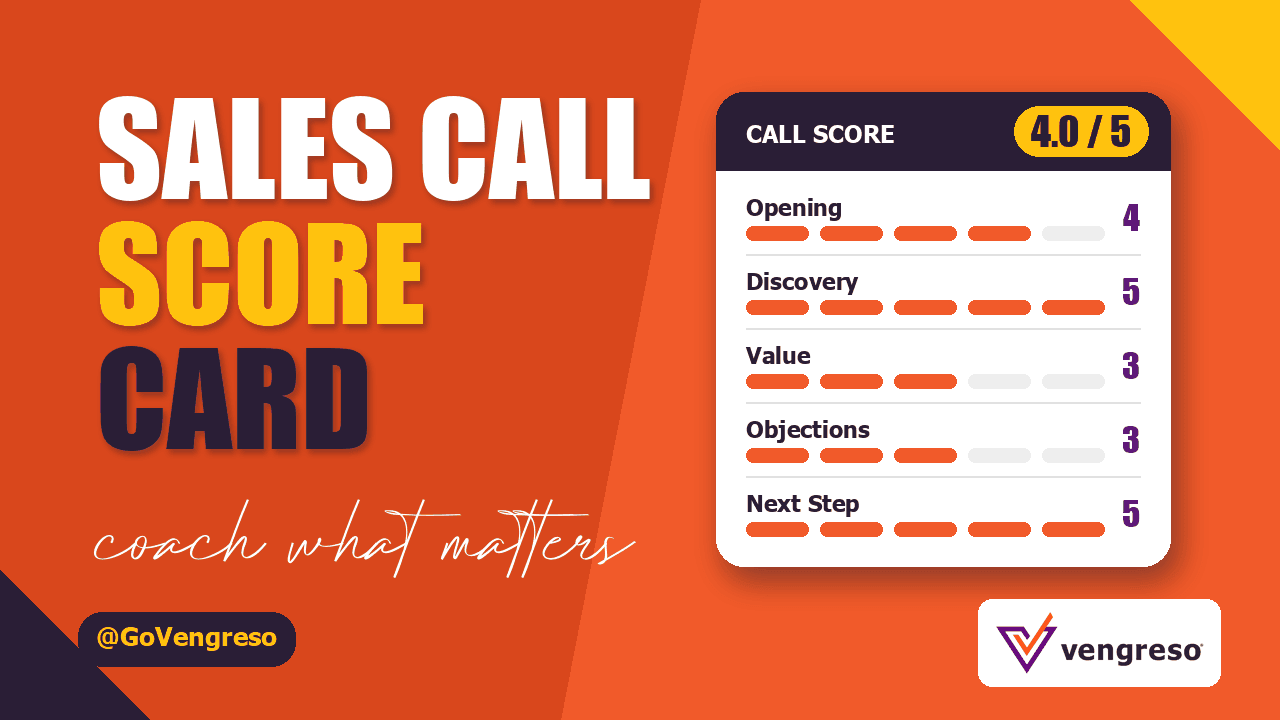

A sales call scorecard is a structured rubric that evaluates what a rep actually did on a specific call, not just whether the deal closed. It scores observable behaviors like discovery depth, objection handling, and next-step commitment. For any sales manager who coaches reps, it is the single most practical tool for turning inconsistent performance into repeatable wins.
This article shows you exactly what to score, gives you a sample scorecard template you can copy into a spreadsheet today, explains how to weight items so reps focus on what drives pipeline, and covers how custom scorecards inside AI roleplay let reps get scored on every practice call before they talk to real buyers.

Key Takeaways
- A good sales call scorecard focuses on observable behaviors during individual calls, not just revenue metrics or quota attainment.
- Weighting items (for example, putting close to half the weight on discovery and next steps) helps reps prioritize what really moves deals forward.
- Sales managers should review scorecards weekly in 1:1s and link scores to specific coaching actions, not just grades.
- Effective scorecards track key performance indicators for sales reps and connect those indicators to real business objectives.
- Tools like custom scorecards inside FlyMSG AI Sales Roleplay and Coaching let reps get scored on every practice call, building habits before they ever face a live buyer.
What Is a Sales Call Scorecard (And How It Differs From a Sales Scorecard)?
A sales call scorecard is a performance-management tool used to evaluate sales effectiveness on a single call. It zeroes in on what happened during that conversation. A broader sales rep scorecard, on the other hand, aggregates results over time. It also shows how performance rolls up across the sales organization and the wider company.
Here is how they differ:
- A call scorecard scores call behaviors: did the rep set an agenda, ask layered questions, handle pushback, and lock a next step? These are leading indicators of future pipeline health.
- A full sales scorecard tracks performance against key performance indicators and key metrics like win rate, quota attainment, average deal size (which indicates the financial value of closed deals), and pipeline coverage ratio, which compares open pipeline value to remaining quota.
- Comprehensive sales scorecards balance lagging indicators (revenue generated, deals closed) with leading indicators (calls booked, discovery quality). Outcome metrics assess business results such as revenue generated and deals closed, while call scorecards measure the behaviors that create those results.
- Sales velocity measures the speed at which a lead converts to a closed deal, and it lives on the full sales scorecard. But the habits that speed up velocity? Those show up call by call.
Think of it this way: your Q1 sales metrics dashboard tells you that a rep closed $140K. The call scorecard from a discovery call on March 15 tells you why she is winning, because she quantified the buyer’s cost of inaction every single time.
Why Your Sales Managers Need a Call Scorecard, Not Just a Dashboard
Dashboards show outcomes. Call scorecards show how your sales team creates those outcomes on each call. Without them, you are coaching from gut feel instead of using actionable insights from call-level scoring, and that does not scale.

- Sales scorecards reveal performance gaps early to facilitate intervention. A call scorecard catches a rep skipping discovery questions in week two, not after a lost deal in week eight.
- Tracking performance at a glance allows managers to see who is on track to meet quota. Scorecards give you that glance at the behavior level, not just the number level.
- Effective scorecards should include both leading and lagging indicators. Call scorecards sit firmly on the leading side. They measure what reps do today that determines revenue tomorrow.
- For remote or hybrid sales teams, call scorecards plus call recording give you real-time visibility into quality, not just quantity. You can review a rep in Austin and a rep in Dublin using the same standard, building consistency across your sales pipeline.
- Sales scorecards help identify performance gaps in sales teams so you can intervene with targeted coaching instead of generic training.
Use call scorecards in weekly 1:1s to track progress on one or two skills at a time. That is where scorecards help drive behavior change.
Core Principles and Key Performance Indicators of an Effective Sales Call Scorecard
Before you build your scorecard, nail these rules. They determine whether your scoring system actually gets used or collects dust.
- Score only observable behaviors. “Sounded confident” is an opinion. “Asked two follow-up questions about business impact” is evidence you can point to in a transcript.
- Keep total scoring criteria manageable. Eight to fifteen items per call type is the sweet spot. More than fifteen, and most managers default to safe middle scores or skip the review entirely.
- Separate compliance items (required disclosures, CRM logging) from selling skills (discovery depth, storytelling). This way you can evaluate both without mixing them, and use distinct review processes for each.
- Use a consistent scoring system across all your scorecards. Whether you pick 0 to 3 or 1 to 5, stick with it and write clear anchor definitions for each point.
- Effective scorecards connect business objectives to measurable performance indicators. Align your evaluation criteria with your current sales motion. If your team runs outbound discovery calls, do not score for renewal-specific behaviors.
- Sales scorecards are used to align daily activities with broader corporate objectives. Make sure every rep understands exactly how each item is scored. Transparency builds trust, and trust drives adoption.
- Sales performance metrics should be measurable and owned by individuals. Each criterion on your scorecard needs a clear owner: the rep on the call.
- Sales scorecards can be improved by focusing on a small number of relevant KPIs rather than trying to measure everything.

What to Score on a Sales Call: Categories and Specific Items
Here is what to put on the scorecard. Break items into clear categories so reps know where to focus and managers can pinpoint gaps fast.
- Opening and Call Control: Did the rep introduce themselves clearly? Confirm the agenda in the first 60 seconds? Ask for available time? A strong opening sets the tone for everything else.
- Discovery and Questioning: Did the sales rep ask open-ended, layered questions? Uncover consequences of inaction? Quantify pain with a number or time frame? Activity metrics measure prospecting efforts like calls made and meetings booked, but discovery quality measures whether those calls actually moved the deal.
- Value and Storytelling: Did the rep link their solution to the buyer’s stated goals, not just rattle off features? Did they quantify benefits using the buyer’s own language?
- Objection Handling: Did the rep acknowledge the objection before responding? Probe the real concern? Stay composed under pushback?
- Close and Next Step: Did the rep ask for a specific, dated commitment? Confirm ownership from both sides? Target completion dates and action items are essential for accountability in scorecards, so “I will follow up” is not a next step. “We meet Thursday at 2 PM with your VP of Ops” is.
- Call Fundamentals: Talk-to-listen ratio, checking for understanding, and avoiding interruptions. These quality metrics tie directly to call scoring consistency and customer satisfaction because they shape how customers experience the conversation in real time.
Sample Sales Call Scorecard Template (Table Layout)
Sales scorecards display key performance indicators in a clear visual format. Below is a table you can copy into a spreadsheet or CRM. It is an example template with one discovery call filled in to show the math. The weights and scores are sample numbers to adapt to your own sales motion, not a research-backed standard and not the weights any tool uses.

| # | Criterion | Category | Weight (%) | Score (0-5) | Weighted Score | Notes |
|---|---|---|---|---|---|---|
| 1 | Opened with clear purpose and agenda | Opening | 5 | 4 | 0.20 | Set agenda, asked for 25 min |
| 2 | Confirmed prospect’s role and authority | Opening | 5 | 3 | 0.15 | Asked role, missed decision process |
| 3 | Asked at least 3 second-level questions | Discovery | 15 | 5 | 0.75 | Dug into cost of manual process |
| 4 | Identified status quo and cost of inaction | Discovery | 15 | 4 | 0.60 | Quantified $18K/month in waste |
| 5 | Connected solution to buyer’s stated goal | Value | 15 | 4 | 0.60 | Tied to Q3 efficiency target |
| 6 | Used a relevant customer example or data point | Value | 10 | 3 | 0.30 | Example was generic, not industry-specific |
| 7 | Handled objection with acknowledge-probe-reframe | Objection | 10 | 4 | 0.40 | Good reframe on budget timing |
| 8 | Maintained balanced talk-to-listen ratio | Fundamentals | 5 | 3 | 0.15 | Talked 55%, target is under 50% |
| 9 | Confirmed dated next step with action owners | Close | 10 | 5 | 0.50 | Booked demo for 3/22 with VP |
| 10 | Captured CRM notes within 15 minutes post call | Compliance | 5 | 5 | 0.25 | Logged immediately |
| 11 | Asked about other stakeholders involved | Discovery | 5 | 2 | 0.10 | Missed multi-threading entirely |
| TOTAL | 100% | 4.00 |
Weighted score = (Weight / 100) x Score. The total here is 4.00 out of 5.00, a strong call with clear room for improvement on multi-threading and talk ratio.
How to Weight Items on Your Sales Call Scorecard
Not every criterion deserves equal weight. Weight metrics based on their impact on sales outcomes. A rep who nails discovery but fumbles the opener still moves the deal forward. A rep who has a perfect opener but asks zero discovery questions goes nowhere.
- One example split you can adapt (a starting point, not a research-backed rule): Opening (10%), Discovery (30%), Value (25%), Objection Handling (15%), Close/Next Step (20%).
- For BDR cold calls, shift weight toward the opening hook and securing a meeting. For AE discovery calls, load weight onto discovery and value. For account manager renewal calls, emphasize relationship health and expansion.
- Sanity-check your weights by pulling three high-performing calls from top performers and three average calls. Score them both. If top performers do not outscore average reps by a clear margin, your weights need adjusting.
- The average deal size in your segment matters too. Higher-value deals typically need deeper discovery, so increase that weight for enterprise motions.
Building Different Scorecards for Different Sales Roles
One generic scorecard for all reps creates noise and confusion. Select metrics that reflect meaningful activities for each sales role. Some teams also track qualified leads when that role owns early pipeline quality. Sales performance metrics should reflect meaningful activities specific to what that role is responsible for.

- BDR / SDR outbound: Score the opening hook, personalization, booking the meeting, and cold objection handling. Unique criteria: “Secured next meeting with a named champion” and “Used a pattern interrupt in the first 15 seconds.”
- AE discovery or demo: Score discovery depth, value articulation, selling technique execution, and close commitment, including how well the rep advances qualified leads. Unique criteria: “Drove multi-threading by asking about other stakeholders” and “Confirmed decision timeline and budget range.”
- Account manager renewal or expansion: Score relationship check-in, risk identification, upsell positioning, and next-step clarity. Unique criteria: “Surfaced renewal risk and proposed mitigation” and “Identified expansion opportunity tied to customer feedback.”
Keep the scoring system (scale and format) consistent across roles so managers can still compare QA scores and patterns across the sales team.
Turning Scores Into Coaching: Cadence, Call Recording, and One-Thing Focus
A scorecard is only valuable if it changes rep behavior. That change happens in coaching conversations, not in dashboards.
- Pick two to three calls per rep each week. Score them before the 1:1. Focus the meeting on one priority skill, not five.
- Regular goal setting increases sales team performance. Set a specific improvement target for that one skill (for example, “increase discovery score from 2.5 to 3.5 in the next two weeks”).
- Use call recording and call scoring together. When a score drops on a key item, pull up that segment of the recording. Identifying skill gaps leads to targeted coaching for sales reps, and timestamps make it fast.
- Example coaching prompts: “Walk me through what you were trying to do in the first two minutes of this call.” Or: “Let’s rewrite your transition question and then roleplay it before your next call.”
Automated scoring on practice calls gives reps feedback right after each roleplay, which means they do not have to wait days for a review.
Practicing With Custom Scorecards in AI Roleplay Before Live Calls
Reps should not wait until a live prospect call to be scored. They can practice and get scored in a safe environment first.

With FlyMSG AI Sales Roleplay and Coaching, reps practice cold calls and discovery calls with AI buyers who push back realistically. After each practice call, they get a score and coaching feedback. Managers can customize scorecards around their own product, objections, and talk tracks, so practice uses the same criteria you use to review live calls.
- Automated call scoring evaluates every call against predefined criteria, so every practice session produces data.
- Team reporting tells you who is putting in practice time, what the average score looks like for each call type, and how many reps sit at each of the five levels, so a team-wide gap shows up before your next round of 1:1s.
- Automated scoring cuts the time you spend grading, freeing you to focus on coaching.
- Assign a specific number of practice calls per week tied to one or two low-scoring criteria. If a rep struggles with objection handling on live calls, that rep practices objection handling in AI roleplay until the score improves. Practice directly supports real scorecard gaps.
Every FlyMSG plan, including Free, includes a small practice allowance. To roll custom scorecards out to your whole team, talk to us about Business Pro Enterprise or Business Pro Enterprise+. Individual reps can also buy a roleplay plan on their own at roleplay.vengreso.com.
Another Model to Borrow: How FlyMSG AI Sales Roleplay Scores Practice Calls
The template above is one way to build a scorecard. If you want another model to compare, here’s how FlyMSG AI Sales Roleplay and Coaching scores practice calls out of the box.
- Scored categories: Two default scorecards, one per call type. The cold call scorecard covers introduction, preparation, rapport building, value proposition, handling initial objections, call to action, professionalism and tone, securing the follow-up, and call duration. The discovery call scorecard covers preparation, rapport, questioning and probing, presenting solutions, handling objections, closing and next steps, overall communication, and call duration. Securing the follow-up carries the most weight on a cold call, and questioning and probing carries the most on discovery. Call duration is scored against a target length the rep can set, about 5 minutes for a cold call and 15 for discovery by default.
- Written feedback: After every practice call, the rep sees what went well, areas to improve and next steps.
- Five proficiency levels: Needs Work, Developing, Competent, Advanced and Expert, so reps can see their progress over time.
- Editable scorecards: Managers can change the criteria to match their own product, buyers and talk tracks.
For SDR cold calls, you can also score the parts of the cold call script we teach at Vengreso: Did the rep ask for 30 seconds and check if it was a bad time? Ask for the meeting before pitching? Use a referential statement and the Big 3 questions (who do you use, when does that contract end, how many users)? Close with what’s in it for the buyer, and set an up-front agreement to reschedule if needed? See the full flow in our 4-part cold call script.
Rolling Out Sales Call Scorecards to Your Sales Team
How you launch the scorecard determines whether your team sees it as a tool or a threat.
- Start by testing the scorecard on two to three volunteer reps. Get their feedback. Refine the criteria and wording before rolling it out wider.
- Clearly separate coaching scorecards from formal performance evaluations or compensation in the first 60 to 90 days. This builds trust and reduces resistance.
- Share anonymized examples of high-scoring and low-scoring calls in a team meeting so everyone can see what “good” and “needs work” look like.
- Present the scorecard in a live meeting, not just an email. Walk through each criterion. Answer questions. Let reps score a sample call together so they feel ownership of the process.
Keeping Your Call Scorecard Useful Over Time (Iteration Without Chaos)
Scorecards should evolve, but constant changes kill adoption.
- Iterate scorecards quarterly to improve their effectiveness. Add or retire one to two items based on patterns from call scoring data and feedback from top performers. Do not redesign the whole thing every month.
- Regularly reviewing scorecards can improve sales team performance. Use quarterly reviews to check whether your criteria still match your sales motion. A new product launch or a shift from SMB to mid-market may require a weight adjustment.
- Document any changes with clear before-and-after examples so reps know exactly what is new and why.
- Keep the call scorecard aligned with broader sales scorecards and team objectives so it always supports pipeline and revenue priorities for that quarter.
Real-World Examples: Scoring Two Discovery Calls on the Same Day
Two reps call similar mid-market prospects on a Tuesday morning. Same product, same buyer profile. Very different scores.
Rep A:
- Rushed the intro and jumped to a product pitch within 30 seconds. No agenda set.
- Asked three closed-ended questions. Never explored consequences of inaction.
- When the prospect raised a budget concern, Rep A immediately offered a discount.
- Ended with “I will send you some info.” No date, no next meeting, no accountability.
- Weighted score: 1.8 out of 5. Discovery and close scores were both below 2.
Rep B:
- Confirmed the agenda: “I want to understand your current process, share how similar companies have handled this, and if it makes sense, find a time to loop in your ops lead. Sound good?”
- Asked layered questions that uncovered the prospect was losing $22K per month to manual workflows. Quantified pain with real numbers.
- When the prospect pushed back on timing, Rep B acknowledged the concern, asked what would make the timing work, and reframed around the cost of waiting another quarter.
- Booked a dated next step: demo on Thursday at 10 AM with the VP of Operations.
- Weighted score: 4.3 out of 5. High marks on discovery, value, and close.
A manager could use these two scorecards side by side in a team meeting to show exactly what the scoring system rewards. No opinions needed. The data speaks. Customer experience starts with how well your rep runs that first call.

FAQ
How many criteria should be on a sales call scorecard?
Most managers should aim for 8 to 15 criteria per scorecard. That is detailed enough to guide coaching but short enough to score a call in 5 to 10 minutes. If you find yourself with more than 15 items, group similar ones under a single criterion. For example, use “Discovery depth” instead of five separate discovery bullets. Inconsistent scores often come from overloaded scorecards where reviewers skip items or rush through them.
How often should I update my sales call scorecard?
Review the scorecard every quarter. Adjust a few items or weights when your sales motion changes, like a new product launch or a shift from SMB to mid-market. Avoid making changes every month, because this confuses reps and makes it hard to compare QA scores over time. Stability builds trust and lets you measure real improvement.
Use call scores privately in 1:1s. Share anonymized or opt-in examples in team meetings to highlight patterns and recognize top performers. Public scorecards expose underperformers and reward top talent, but public shaming of low scores usually hurts engagement. Celebrating improvement, not just high scores, encourages reps to lean into coaching.
What scoring scale works best for sales call scorecards?
Simple scales like 0 to 3 or 1 to 5 work best. What matters more than the numbers is having written definitions for each point. For example: 0 = not done, 1 = poor, 2 = acceptable, 3 = strong, 4 = excellent, 5 = exceptional. Clear anchors reduce inconsistent scores between managers. Without calibration, two managers can score the same call very differently, so score a few calls together before you roll out.
Can I use the same scorecard for live calls and AI practice calls?
Yes, and you should. Using the same criteria and weighting for live calls and AI practice calls creates one standard for what “good” looks like. This is why managers often mirror their live scorecard criteria inside tools like FlyMSG AI Sales Roleplay and Coaching. Every practice session builds the same habits they expect on real calls.
Next Step for Sales Managers
You now know what to score, how to weight it, and how to turn scorecards into coaching that drives behavior change. Pick one call type, build your first scorecard this week using the template above, and score two calls before your next 1:1. The data will tell you where to focus, and your reps will thank you for the clarity.